Showing posts with label shopping,textiles. Show all posts

Monday, 2 May 2022

FASHION: Social injustice in focus

 Fashion is both a reflection of and a catalyst for social change, and can play a crucial role in social justice. Social justice in fashion considers fair distribution of resources, the elimination of institutionalised domination and oppression, and the consequences of fashion decisions made in one place on another, and by one generation over those yet to be born.


The story of fashion and the story of the many fashions that make up our lives stem from a variety of influences and also personal references. Culture also plays a huge role, for some more than others. our fashion developed against a backdrop of varied street styles, music influences, and contemporary fashion scenes. some, develop a taste in multiple styles of fashion and clothing influenced by varied Western street styles alongside other culture diaspora styles, too. for example British Indians. 

So what might an intersectional approach to fashion look like? How might fashion centre the stories of fashion beyond Europe and of the producers alongside designers?what do we know about the work of design activists and movements that challenge inequalities in fashion, such as unfair labour practises and cultural appropriation, as a way for students to reimagine fashion. This approach leads to questions of ethics, social justice, accountability, appropriation, indigenization, and decolonization.

Such an approach echoes what theorist Arturo Escobar calls a design for the pluriverse. The term pluriverse, originally used by the Zapatistas, the Mexican revolutionary political and militant group, envisions a decolonial political world in which many worlds coexist and thus destabilises the concept of universality that has historically justified processes of colonial domination. The notion of the pluriverse acknowledges the entanglements and interconnectedness between different ways of being in the world, and Escobar argues is a way to regenerate people's spaces, their cultures and communities, and to reclaim the commons.

So, what's more fashionable, London's Bond Street or  for example Ealing Road, home to South Asian fashions in West London? The question is used as prompt to explore examples of marginalised forms of fashion practise that originate from the global South and show alternative counter-hegemonic ways of making fashion. While both areas have stalls with high-end luxury fashions, the fashions are very different. In Ealing Road, saris, a pre-colonial garment in the form of unstitched cloth, dominates the storefronts.

These discussions also open space to discuss more sustainable and social-justice-oriented ways of making fashion, such as the Sari for Change brand that trains low-income communities to recycle saris, to historical examples, such as the London-based campaign group Sari Squad, a group of women, mainly of South Asian origin, who wore saris as a form of visible protest against far-right racist groups in the UK in the 1980s. 

This can lead us to question how an alternative social-justice-oriented fashion design might address how colonialism and imperialism is about economic exploitation and dominance, and to understand why the Westernised fashion system operates to maintain cultural hierarchies. This involves a much deeper critical examination of how power operates globally in fashion to create and sustain racist and sexist hierarchies, and the role of coloniality thinking that established a justification for some, mainly European, countries to appropriate the land and resources of other countries.

Through this analysis, the fashion community can focus on three urgent issues. Firstly, how the option to decolonize fashion is more than about racial diversity. It's a long-term process to find ways for fashion colleges, fashion brands, and consumers to expose and offer alternatives to Eurocentric ideas about fashion. To do this, fashion needs to learn not just from designers, but also vernacular, everyday forms of fashion alongside grassroot activists to focus on ethical and environmental issues in fashion.

Secondly, it's more than about acknowledging colonial paths. To decolonize fashion requires moving towards alternative, anti- racist, and non-capitalist forms of fashion-design practise by learning with and from the global South. And thirdly, and most importantly, we need to decide whether we can even reform fashion-design cultures and practises, given the harm they are currently causing people and the planet, or whether we should be transforming and reimagining the fashion-design process altogether.

Journalist and campaigner Tansy Hoskins has explored the capitalist and patriarchal roots of fashion-design manufacturing, production, and consumption, and calls for a revision of the entire fashion-design system. And design theorist Sasha Costanza- Chock outlines the need for design justice, a design approach led by marginalised groups to challenge universalist design principles and practises.

So we need to urgently rethink fashion away from industry and towards people's lived experiences as a way to encourage a more relational and human approach to fashion, designing with people's differences to include everybody's fashion stories. It's only through doing this that a reorientation of fashion design towards a more ethical and political practise can be achieved. For fashion design to learn from rather than exploit marginalised and subaltern groups, it must create and offer spaces in which heterogeneous concepts of fashion can thrive and flourish.

There is an urgent need to explore alternative non-extractive, anti-racist and social justice-oriented forms of fashion design pedagogies.


ENVIRONMENTAL INJUSTICE 

GHANA

https://theor.org

An estimated 15 million items of unwanted clothing from the UK, Canada, USA, China, South Korea, Australia and other countries pour into Ghana each week.

Whilst Ghana is not the only country where unwanted clothing is ‘dumped’, what is happening in Ghana offers a stark example of environmental injustice.

These clothes are commonly known as obroni wawu – dead white man’s clothes. Secondhand clothes imports have created environmental disasters in Ghana, as well as severe health risks for the people who live and work around the related markets and landfill sites. The term ‘waste colonialism’ was first used at the Basel Convention in 1989, to describe the transboundary disposal of hazardous and toxic wastes.

https://eco-age.com/resources/decolonising-fashion-dead-white-mans-clothes-ghana/

Most of the items of clothing arrive at Kantamanto Market, the second largest secondhand market in West Africa. The market creates jobs for many people, and provides a space for entrepreneurs and styles. Products are curated, upcycled and, in some cases, sold back to other countries ‘with a little Ghanaian flair’.

https://www.abc.net.au/news/2021-08-12/fast-fashion-turning-parts-ghana-into-toxic-landfill/100358702

The market is also the site of backbreaking work for the female head porters, called kayayei, who carry the massive bales of clothes on their heads and risk serious injury.

Around six million items of the clothing leave the market as waste each week to be dumped. The destination of the majority of clothing waste from Kantamanto Market was, until 2019, Kpone landfill. More than 60% of the waste in this landfill site is estimated to be clothing. Waste pickers and the communities faced nausea, headaches, drowsiness, fatigue and respiratory problems, originating from the site.

The clothing waste began to overwhelm Kpone landfill within five years. Then, in August 2019, Kpone went up in flames, creating further respiratory problems, emitting noxious fumes and creating increasingly dangerous working environments for waste pickers. The site burned for 11 months.


The landfill site was decommissioned and capped in 2020, displacing over 300 waste pickers and levelling their community space.
Clothing waste in legal and illegal dumping continues to cause devastating problems in Ghana. It will continue to do so for as long as it takes the polyester, viscose and acrylic to decompose.
There isn’t capacity to transport all this clothing waste to new landfill sites, so it ends up in the streets. Here it creates environments for pests and disease to thrive. This clothing waste blocks the drainage and water systems, and damages the city’s ability to deal with life-threatening floods. Once the clothing has made its way to the ocean, it washes up in tangled knots of clothing or gets clogged up in the sand, up to 15 feet deep.

environmental justice map: https://ejatlas.org


Challenges and opportunities for human rights defenders in global fashion supply chains
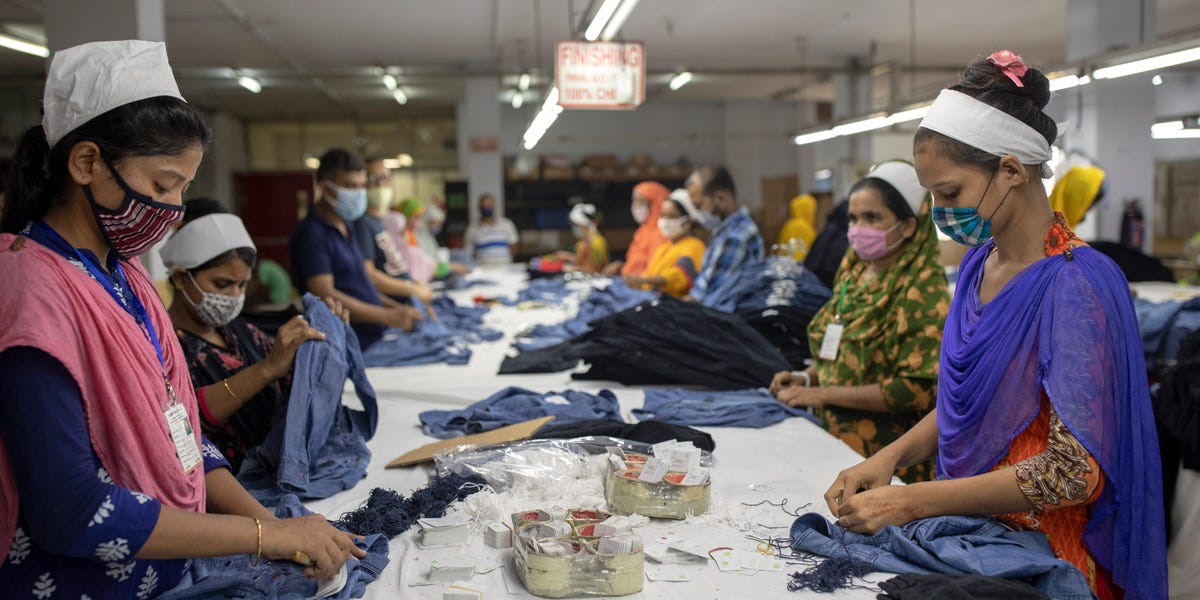


women make up over half of the garment sector workforce in Asia. They are disproportionately represented in low-wage jobs in the lower tiers of garment sector global supply chains. The report found that the average gender pay gap in the garment sector (in nine countries in Asia) is approximately 18 per cent. Worldwide, women in the garment sector are denied rights to maternity leave or childcare. They also face commonplace instances of intimidation, sexual abuse and harassment in workplaces as well as on the way to or from work.

Bangladesh Centre for Workers’ Solidarity campaigns for worker safety, fair wages and the right to labour unions.

Those involved in the campaign face risks, challenges and opportunities of being a human-rights defender but they feel it's worth it. In these factories issues such as unsafe working conditions, union-busting, insecure hours and wages, gender inequality, violence, and criminalisation are everywhere and justice needs to be sought. Everyone has a fundamental right to life and safety, Through collective action the campaigners believe, “change can come when workers fight together”. campaigning workers face tough times their voices criminalised,  fired and blacklisted just for raising their voice asking for a safe gender-based-violence-free workplace, and dignified wages.


children as young as 8 or 10 start working In the factories, working 100s of hours for a mere few dollars a month, on the feet all day for 10 hours or more, working in poor, dangerous and unhealthy conditions.

Covid-19 hit factories and therefore workers hard, brands just cancel their orders or deny to pay the bill that they would owe to the manufacturers, this directly impacted the workers. no work no pay. resulting in lack of money to buy food for themselves and their families.

This needs to be changed. And these changes can come when workers are united, when workers are fighting for their lives together one of the best tools for this is a union. Forming unions and joining with a union makes them united and strong, and their collective voice can bring the changes.

The unions are important because, in many cases, the laws of the country are not enforced. For example in Bangladesh there is a labour law, though it's not adequate or often enforced because there is a power collusion between business and politics.


 if there is a strong union in the factory, they can do the collective bargaining agreement with their respective factory management over the demands they have. And sometimes that agreement can be even beyond the law. for example living on poverty wages, but through the union agreement, if workers give a demand to receive a living wage, that can be discussed. 

Fashion Checkerhttps://fashionchecker.org

Union's are also important if women workers are willing to discuss gender-based violence during their collective bargaining agreement. It t can be discussed, and resolution can come to set up a committee in the factory and resolve all these problems and eliminate all the gender-based violence from the respective factories so that it would be a women-friendly workplace.

The campaigner workers sometimes face criminal charges, are often threatened, beaten, forced to fight .Being fired and blacklisted is very common.

When they defeated however, they still stand back up and fight did they start to win. Through a collective voice, through a union voice and union collective agreement, a change can become. A change is possible.

Clean Clothes Campaign: Amplifying worker voices in the garment and sportswear industry

Saturday, 9 April 2022

Fashion: textiles in Ghana


KENTE

Kente (Akan: kente or nwetoma; Ewe: kete; Dagbani: Chinchini) refers to a Ghanaian textile, made of handwoven cloth, strips of silk and cotton. Historically the fabric was worn in a toga-like fashion by royalty among ethnic groups such as the Ashanti and Ewe. It is also worn by queens, princesses and women of Dagbon.


 in the Ashanti region of Ghana, Kente cloth is a great status symbol, marking your wealth and, in the past, your office. Something to be worn on important occasions and by important people.

A typical Kente fabric is woven in narrow strips. Each strip contains a series of bands, designed in intricate, multicoloured, geometrical patterns, alternated by other bands of simple, linear designs in contrasting, co- ordinating colours for harmonious effect. 
Each pattern is named after a historical event or a person, or is connected with a proverb.

the weaving process:
the design determines the colours of the yarns that he has to put on the bobbin and, subsequently, on the wool.The process, is to put the warp thread into the heddles and  beater and work according to the design pattern.After putting the warp thread into the various heddles and beater, the whole thing is brought into a loom for the weaver to start to weave it.There are two sets of heddles. The first set is used in making patterns and the second set is used in being regular weaving, where no patterns are required. to make one strip is takes arounds  eight hours of hard work. 
the original Kente designs were black and white. The cotton used grown locally. The black and indigo colours were locally made using local available dyed colours. The weaver had no contact with the rest of the world, so he had no access to the variety of colours that we have today hence the colour choice, up until the development of the "Gold Coast" which also introduced not only colours but also silks.

With modernisation, there have been many changes In the past only black, red and golds were used, but nowadays more colours are available. colours may not always be exact but they are used in producing traditional designs in modern fashionable colour patterns, in order to make people attracted including metallic thread for a "party" look.

Adinkra

Adinkra is a printed fabric - hand-made and worn mainly for funerals, an important celebration in Ghana. Adinkra fabric is carefully printed in graphic symbols of geometric motifs, on a background of white, rust-brown, or black vegetable-dye fabric. Any one of the motifs, or any combination of them, could be arranged in narrative patterns to convey specific messages.
These messages may be expressed as a reflection on issues pertaining to beauty, morality or other higher values. 

The black dye for the cloth is produced from kuntun kruni - the roots from the kuntu plant. To make it ,twelve buckets of water are used to make one barrel with twenty-five strips of the roots put into it and stew for 2days. when you put in the white cloth first it looks like brown, but by two weeks’ time it will change into black, leaving it to seep and be dyed for two weeks, leaving it in the sun. When it dries you bring it back, and wet it again, and dry it again, repeating this process six times.  ‘Badie’, the hard bark of the tree found only in the Savannah areas is broken into pieces and soaked with water for twenty-four hours. The softened bark is pounded in a mortar and is used to produce the dye for stamping the symbols.Repeated boiling and filtering produces a concentrated solution.Out of forty-eight gallons only one gallon of the solution is produced.
The Adinkra stamps are carved from the wood CU stamps being of a gourd or calabash, by a professional carved designer and carver, such as, Joseph Kofi S/I Nsiah.


Kente is associated with important occasions, but it is linked especially with high social office and is more of a wealthy person’s status symbol, whereas Adinkra is associated with funerals and thus important but solemn occasions in the lives of everyone.

Kente is designed to be felt (‘beautiful’, like silk) as well as for appearance, it uses imported rayonsAdinkra is designed to be looked at and requires local supplies for the dyes.

Ways of making kente and adinkra have shifted and continue to shift.  kente weavers first used cotton and vegetable dyes, then bought silks from European traders, before beginning to use rayon. The most recent introduction is the use of lurex to achieve ‘glitter’. Vegetable dyes are used for adinkra, black and white or coloured, some cloths thave black-stamped designs on red and blue grounds

Kente is very time consuming to produce, with one strip of the best cloth taking at least a day to make with grades of skill (only 10% of workmen are able and willing to make some difficult designs due to time and skill needed. under the control of 1 man, taking even longer before as thread used to be homespun) 

Adinkra takes several weeks to make and involves the input of dyer, stamp carver, and printer in a collaborative process.

With kente the decisions and exact calculations take place right at the start, before the weaving begins. The design and colour choices must be thought out before warping up the loom, and the plan must then be steadily and accurately followed through with no changes.

Adinkra depends on a lengthy dyeing process (of six dippings) to obtain the depth and evenness of hue. It requires precision, speed, and decisiveness at the printing stage. Design activity is concentrated towards the end of the making process.

no matter which design buyer is acquiring skilful design and execution.

Wednesday, 27 May 2020

fashion: How gender inequality affects women in fashion supply chains

Approximately between 60 and 75 million people work directly in the fashion and textiles industry and around 70 to 80% are women. Many are subject to exploitation and verbal and physical abuse. They often work in unsafe conditions, without basic healthcare and with very little pay.

What is gender equality?

Gender equality refers to the equal rights, responsibilities and opportunities of women and men and girls and boys. Equality does not mean that women and men will become the same but that women’s and men’s rights, responsibilities and opportunities will not depend on whether they are born male or female. Gender equality implies that the interests, needs and priorities of both women and men are taken into consideration, recognising the diversity of different groups of women and men. Gender equality is not a women’s issue but should concern and fully engage men as well as women. Equality between women and men is seen both as a human rights issue and as a precondition for, and indicator of, sustainable people-centred development
The fashion industry has historically been divided by binaries – London Fashion Week Men takes place at a different time to the main womenswear shows, for instance – and we need to look at how the industry as a whole can be more inclusive of LGBTQIA+ communities and work to reduce gender-based discrimination, exploitation and violence towards all people working across the value chain.

Why does gender inequality persist?

Gender inequality exists because men have been dominant throughout history. If we look back at thousands of years of cultures, societies, religions, economies and political organisations, they have one thing in common: women’s status is subordinate to that of men. Men possessed the political and economic power in the pre-industrialised world and, as a result, were able to take advantage of the opportunities industrialisation presented and this perpetuated the subordination of women. 
Textile and garment factories take advantage of a large pool of young, female workers, often from rural areas, who can be employed at low wages. This model has persisted from the early days of the Industrial Revolution through to present-day developing economies. For example, Cromford Mill in Derbyshire, the world’s first water-powered cotton spinning mill built in 1771, employed 1500 workers, four-fifths of whom were women. Today in Cambodia, most garment workers are young women (aged 18-25) who migrate from poor rural areas to the capital Phnom Penh where the majority of garment factories are located. A 2019 World Bank report found that just six countries give women and men equal legal rights. This is an improvement from a decade ago, in which the report found that no country guaranteed full legal equality.
Globally, women are estimated to earn 77% of what men earn, although these figures understate the real extent of gender pay gaps, particularly in developing countries where informal self-employment is prevalent, and almost 40% of women in wage employment do not have access to social protection. Sexual harassment is a regular occurrence. According to CARE International, nearly one in three women working in garment factories reported experiencing sexually harassing behaviour in the workplace over the last 12 months. Out of 180 workers in Bangladesh, interviewed for the Microfinance Opportunities/Fashion Revolution Garment Worker Diaries project in 2017, 60% reported gender-based discrimination, over 15% reported being threatened and 5% had been hit . More than one-third of countries around the world do not yet have any laws prohibiting sexual harassment at work, leaving nearly 235 million women vulnerable on a daily basis . It has been estimated that not responding to issues of gender-based violence in factories in Cambodia has cost the fashion industry US$90 million.
No alt text provided for this image

What are fashion companies doing to address gender inequality?

Despite global fashion brands’ reliance on women in their supply chains, on the shop floor and within their companies, they are doing surprisingly little to address gender inequality and empower women. In the 2020 Fashion Transparency Index which covers 250 of the world’s biggest fashion brands and retailers, only 7 brands (3% of brands) disclose how they involve affected women and women’s organisations in their due diligence process. Meanwhile, only 2 brands (less than 1% of brands) publish data on the prevalence of gender-based violations in the supplier facilities. 
It is estimated that gender gaps cost the economy some 15% of GDP but whilst 49% of brands in our Fashion Transparency Index publish policies on equal pay, only 34% of brands publish the annual gender pay gap within their company and these tend to be UK companies which, as of April 2018, are required to do so by law 
No alt text provided for this image
Women must be able to participate in and benefit from development if we are to achieve SDG 1: No Poverty and SDG 5: Gender Equality. The ongoing marginalisation of women at work has prevented them from developing their full potential and impeded inclusive and sustainable development. However, there is a growing body of evidence demonstrating that happy, healthy, protected and empowered women are good for business and ultimately good for the world.
Research by the Good Business Lab was carried out at five factories operated by Shahi Exports, India’s biggest garment exporter, around the impact of Personal Advancement and Career Enhancement (P.A.C.E.) training, a life skills course for female garment workers designed by Gap Inc. Workers who participated in the programme became more valuable employees: they were more productive and assigned more complex sewing tasks. Nine months after the programme had been completed, not only were the women happier, more confident, trained in problem-solving and decision making and financially literate, but the researchers calculated the net rate of return on investment in P.A.C.E. training for workers was around 250%. This means for every U.S. dollar they invested in training women, they got $2.50 back. 

Garment Worker Diaries

Why the fashion industry must invest in women

Investing in women is a win-win for the fashion industry as it improves the wellbeing of workers and improves the bottom line. So why are more brands not investing in the women in their companies and in their supply chains? Dominic McVey, non-executive director of HELA clothing which has grown from US$20m to US$200m turnover in 5 years by investing in its workforce simply states: “There’s a lot of people out there with earplugs in”.
No alt text provided for this image
UN Women. Facts and Figures: Economic Empowerment

fashion: Goal 1: End poverty in all its forms everywhere

An average consumer does not realize how often they come across cotton during the day, right from the bedsheets, their towels, their clothing, and even currency notes. Cotton being a traditional crop, it has a lot of history with it. It is one of the colonial crops as well. China and India are one of the largest producers of cotton, but it is grown in the US, Australia, in many countries and Africa as well and Central Asia like Kyrgyzstan, Tajikistan as well.There isn't an accurate number but it is an estimate that about 70 % of world's cotton is actually grown by smallholder farmers, which means farmers who have an average land of two or three hectares, or you could compare it to two or three football fields. We have plantations in some countries where everything is mechanized so that's a totally different scenario. For example in the US, Australia or other developed countries.
If you're talking about the smallholder farmers so you can yourself visualise if that farmer owns just two football fields of farming and their whole family needs to depend on that one crop. Usually one crop for the income, so it isn't enough for the family to live on it and as I mentioned there is a cycle of poverty in terms of money lending and the interest that they have to pay. So there's very little left for them in order to be able to live on that income.
No alt text provided for this image
So a farmer in Africa who has just two hectares of land has to sell his cotton at the same price as a big farmer in the US who has acres and acres of land and is being subsidised by the government so this is one of the biggest factors that perpetuates poverty. It's not not just poverty there are other factors that come in for example the amount of chemicals that they need to use for their farming. Not only does it reduce the quality of the soil but it also reduces the quality of their own health , thier children and the animal or the cattle that they might have, these days the seed that they need to buy.
So firstly not only are they dependent on external parties to buy their seed but they also have to pay a lot of money in order to be able to get access to water , and of course now climate change is also affecting farming everywhere and in some cases the farmers might not even be aware about climate change and they're still leaving it as you know this is the wrath of nature maybe. So you know that education needs to be there, because of poverty sometimes they need to use include the children in the farming or cotton picking, which means the future generation also would still be trapped in poverty unless the kids go to school. Fairtrade is a grassroots movement where the wider goal of making trade fair and there are two main tools that Fairtrade uses to support the farmers. The first is the Fairtrade minimum price. It is a safety net, and if the market crashes then at least the farmers are able to recover the cost of of production or as I mentioned that there are subsidies in other countries which brings down the cost of world prices of cotton. So this this helps them to recover their prices, it is just a safety net. But on top of it the farmers get a small amount which is called a fair trade premium.
This amount goes to the co-operative of farmers and they themselves democratically decide how they want to use this money. So it is an empowering model. It's no one sitting, and it's not the brand or us sitting in London or New York telling them how to use their money because they know the reality the most, and they often decide to use it in investing in education or improving their farming etc. So it is really an empowering model for the farmers. Certification is an assurance for an average consumer that someone has checked that everything is OK, and as we know that the trust that consumers have in businesses has really been been going down.
No alt text provided for this image

So it just brings that added value rather than someone's themselves saying we are good when a third party confirms that or verifies the good work that they are doing. I think that is the value it brings for the consumer if they recognise and trust a mark like Fairtrade. It shows them that some thing right has taken place in the supply chain or the farmers have received a fair price for their product. Certification is a big part of what Fairtrade does but it is not limited to certification. There is a lot of work that we do on campaigning advocacy, bringing producers together, forming a network, giving them a platform, and Fairtrade is actually represented 50 % by producers. So it is the voice of producers, so that it is not a paternalistic approach to development. It is very inclusive and participatory in terms of what they want and we use that further to influence governments and consumers, educating consumers businesses and governments to make trade fair. Governments have a very crucial role to play both in the north as well as in the south to create an enabling environment for a fairer term, for fairer terms of trade for the farmers. The governments in the developing countries also need to invest in infrastructure, like hospitals, schools and even value addition in those in those countries. So that these farmers can have a decent life. And. Help them to come out of poverty.  the first thing that the companies need to do, is to acknowledge that farmers are part of the supply chain too so they are the invisible part of the supply chain. And then the second step is to have more transparency, to know where their stuff is coming from, and of course then there is fair trade. They can use Fairtrade as a tool to ensure that there is no child labour, that farmers are getting a fairer price, and that the money is actually reaching the farmers so the additional amount that the consumers are paying is actually reaching the farmers because of the insurance model that we have. Consumers have a really strong voice. if they can signal and give strong messages to the brands and to the government that they care, and that the farmers should also get a fair price, there is no reason why the industry will not will not change, because the brands are always looking towards the consumers and what they ask for. It is about fairness that it should be fair for everyone in the supply chain, including the invisible farmers who grow the cotton that is in your clothes ,that should be fair for the businesses, and it should be fair for the consumers.
No alt text provided for this image

Thursday, 21 May 2020

Fashion and fetishism

Why do clothing and fetishism often go together? How to explain clothing fetishism?

The word ‘fetishism’ has a long and very complex story. It is first used in French by Charles de Brosses, a colonist of the eighteenth century to refer to the cult that ancient pagan religions pay to material objects. These sacred material things are called fetishes. In these times, fetishism is considered to be a feature of underdeveloped civilizations and bears a negative connotation. Fetishism is perceived as a set of superstitious beliefs opposed to the rationality prevailing in the Century of Enlightenment in Europe. 

Psychoanalysis and Marxist economy have in a way extracted fetishism from its colonial anchorage. Freud observes that among his patients, some of them demonstrate a fetishist behavior: 
they have erotic desire for inanimate objects, or to be more precise, they cannot feel sexually aroused or satisfied if they miss a certain type of inanimate object. 
Freud’s interpretation is that the fetish "is a substitute for the woman’s (the mother’s) penis that the little boy once believed in and... does not want to give up.... if a woman has been castrated, then his own possession of a penis was in danger." So according to Freud, fetishism is a solution to the castration complex coming from childhood experience of the gender alterity.

https://www.amazon.com/Fashion-Fetishism-Corsets-Tight-Lacing-Body-Sculpture/dp/0750938080

Two questions follow then: 
1/ are there privileged objects for fetishism? 
2/ are men the only fetishists? 


Freud observes that the organs or objects chosen as substitutes for the absent female phallus are not necessarily symbols of the penis. It seems rather that when the fetish is instituted some process occurs which reminds one of the stopping of memory in the original traumatic situation. It is as though the last impression before the traumatic one is retained as a fetish. Thus as Freud says, "the foot or shoe owes its preference as a fetish to the circumstance that the inquisitive boy peered at the woman’s genitals from below, from her legs up; fur and velvet are a fixation of the sight of the pubic hair; pieces of underclothing, which are so often chosen as a fetish, crystallize the moment of undressing, the last moment in which the woman could still be regarded as phallic". This is why corsets, shoes and boots, underwear but also leather pieces that are often treated as a second skin, are favorite items for fetishist practices and symbols of this subculture.

https://indie-mag.com/2018/03/fetishism-in-fashion/
Because fetishism is an answer to the castration complex, it would appear at first that fetishism is strictly a masculine sort of behavior. In a recent book on fashion and fetishism, fashion historian Valerie Steele notes as well that fetishism is more widespread among men than women. But in an earlier text on fetishism, Freud said that "all women are clothes fetishists". He also adds that even the most intelligent of them follow demands of fashion, even if it is not to their advantage. It is difficult to forget the phallocentric character of the psychoanalytic take on fetishism and to go beyond these obviously misogynist reflections but it is interesting for us to discuss the possibility of an equivalent to fetishism for women, and to the specific function of fashion in this context. 
According to Freud, feminine fetishism for clothes in general has to be explained according to the woman’s quest for the phallus which is the symbol for masculine power in Freudian theory. But it would be too simple just to say that clothes are fetish for women because they make them more appealing to men.
It seems, on the opposite, that women enjoy clothes not because of the mens’ gaze, but because clothes play a role in their own identity process. Women, exactly as men, make use of fetishes to feel complete, to feel as a whole, and to conjure up the threat that the original discovery of the gender difference might have caused. But why is fashion relevant in this case? Probably because the fetish is by definition an illusion: the fetish takes the place of the missing phallus, it is a fiction about something missing. So no actual single object can really fill that void, and the subject is doomed to try one object after the other and keeps looking for the right fetish that only exists as a fantasy.


Hence the power of fashion and its constant shifts: the success of fashion is based on the fetishistic relationship to clothes
As we want our clothes to fill a gap that cannot be filled, we only derive partial and temporary satisfaction out of them and need new dress all the time. It is quite interesting that, from the years 1960’s on to now, mainstream fashion has adopted many of the codes of the fetishist subculture: leather, rubber, cruel shoes, tattoos, body-piercing, underwear as outerwear, corsets, which were all more or less dedicated to private and special use, became quite common on catwalks and advertising campaigns, pervading even high street fashion. Designers like Vivienne Westwood, Gianni Versace, Alexander McQueen, Jean-Paul Gaultier or John Galliano have contributed to put fetishist outfits on the public place, and to promote a sexual chic style that owes a lot to a sartorial material that was considered evidence for perverted habits. This long lasting fashion trend has been criticized both for degrading the woman’s image, and for spoiling the true fetish culture, making it too commercial and meaningless.


Fashion clothes are also a surface one projects her own fantasies onto: they help us to imagine other identities for ourselves, and to build new identities for ourselves. And as Freud and many other authors have established, sexual life is critical in the definition and construction of the self, so it is no mystery that clothes in general, being so intimately connected to the body, bear so many sexual connotations.
Feminist critics have attacked these uses of fetishist references as positioning women as objects or victims. It might hold in some cases, but in many others, women wearing these kinds of outfits were on the opposite pictured as dominant, strong and free. As Valerie Steele has written, "the attraction that many women have to fashion—and fetish fashion, in particular—may be related to their desire to assert themselves as independent sexual beings". It might be a good explanation, after all, for the sex appeal of the inorganic that Walter Benjamin associated to the cult of the commodities in the modern era. Fashion clothes are not only ways to cover oneself, or to express one’s personality, social role, or current mood.

Wednesday, 20 May 2020

FASHION: the signature, the brand name

“Fashion & Society”, the article by Pierre Bourdieu and Yvette Delsaut 
“The fashion designer and his signature: contribution to a theory of magic”
 helps us to identify the logic of functioning of the fashion field, polarized between former dominant actors and new contending actors. Focusing more precisely on the mechanisms for creation of value from fashion brands, let us now study the second part of the text. How do fashion brands create value? Is this value based entirely on material considerations (quality, know-how, etc.)? What is the importance of fashion discourse?


The magic of the “signature”
First of all, both sociologists note that it is impossible to conceive the value of a symbolic good from the perspective of its materiality, since they consider that the simple signature is endowed with its own value. This leads them to define the production operation as “an operation of symbolic transubstantiation irreducible to a material transformation”, in particular through the imposition of a signature. This is how the licensing and diversification strategies put in place by couturiers in the 1970s can be understood. Cardin, Féraud or Lapidus decided to transfer the material manufacture of some of their products to other companies (licensees), only to end up imposing their brand against a royalty of 5% of the turnover achieved, following a pure symbolic logic. While the strategy is ultimately comparable to literary and musical production, where the author generally entrusts the production and distribution to others, the fact remains that we do observe an operation of separation between the material and symbolic part of the production. This can be seen for instance with Saint Laurent’s latest attempt of diversification for the opening of its Rive Droite boutique. By producing various objects in partnership, the company essentially imposes its logo without producing it itself, the operation obviously having an impact on the value and price of the product. “If there is one case where we do things with words like in magic, even as in magic (if the magician never does anything other than sell with words the idea that he does something with words), it is in the world of fashion” say Bourdieu and Delsaut, drawing the analogy between magic and fashion brand, between magician and designer.
The arbitrary value creation
Bourdieu and Delsaut highlight the purely arbitrary logic of value creation operated by fashion labels, a creation that is particularly effective because it is based on the “collective ignorance” of consumers. Their creation is identified as a “symbolic capital transfer operation (…) by which an agent or, more precisely, an institution acting through a duly mandated agent, invests a product with value”, the creator’s power being his “ability to mobilize the symbolic energy produced by all the agents involved in the operation of the field”. The press is one of them, as are buyers, loyal customers or competing creators. It is therefore a question for a brand to rely on this network of actors - the field of haute couture - to arbitrarily endow a tangible product with an intangible and symbolic value. Like painting, whose value cannot reside solely in its technical aspect, and is based on a network of critics or galleries, fashion also consists of a media field, a network of buyers and competing designers. This is how we can read the success of some fashion designers and suggest that this success can, more than the quality of their products, be based on an “objective collusion of interests” of the actors of the field.
The celebratory function of the fashion discourse
Thus, fashion discourse only serves a celebratory function or a “performative enunciation”, under the pretext of an apparent objectivity. Let us mention here the case of Vogue. If the successive clothing objects are haloed with an apparent descriptive objectivity, the fact remains that they essentially aim at an advertising logic intended to crown certain products to the detriment of others. The whole effectiveness of the system depends on the fact that its own actors are not necessarily aware of it. Can a journalist sincerely believe in a designer’s genius and praise him without being aware that he is an indirect part of this logic of consecration and increase of the symbolic capital of the creator? 
And it is precisely competition between actors in the same field that tends to hide this arbitrary production of value from consumers and divert their “revolutionary energy”. A consumer disappointed by designer X can certainly switch to designer Y, but his energy will not go against X and he will not challenge the collective ignorance mechanism in place, hence this form of “stability through change” typical of the fashion field.
Fashion and its consecration cycle
As an operation of “transubstantiation” and “ontological promotion” of the material product, the fashion label takes place within what the two sociologists call a “cycle of consecration”. If the production of a material good, a garment in this case, obviously starts from material production, the fact remains that it continues well beyond that. The authors take here the example of Van Gogh in that it would be naive to believe that the painter’s production work is limited to the simple act of painting, this one being accompanied by his journey, his cut ear, as well as his many adventures. Similarly, in the field of fashion production, a Chanel bag is symbolically accompanied by the entire mythified history of G. Chanel, but also by that of K. Lagerfeld, and is not limited to its simple production.
Bourdieu and Delsaut also note that the cycle of consecration of a symbolic good is directly proportional to the importance and length of its consecration circuit. A “good” symbolic capital therefore implies a long consecration cycle, based on a multitude of actors. It is certain that a fashion designer who would only be praised by an article from an obscure fashion magazine cannot benefit from a significant symbolic value. On the other hand, if the designer succeeds in involving buyers, the media and collecting a lot of praise from other designers, it will be much easier for her to build up a strong symbolic capital, obviously associated with the success of her clothes.
The second part of Bourdieu and Delsaut’s article therefore brilliantly contributes to the understanding of the mechanism responsible for the value of the fashion object, oscillating, like many sectors of symbolic production, between material and immaterial elements. More than just material design, the role of the fashion designer is defined by his ability to mobilize a multitude of actors in order to increase his symbolic capital, directly depending on the success of his brand or the company she manages.

Fashion business models

 at an industry level, we can see that fashion is a sector that is a kind of epitome of globalization. Every country in the world is more or less positioned as a customer or supplier for other countries, and the integration of countries is very strong in the sector. This is due to the fact that, in fashion, you have quite low technical barriers to entry, and very low cost countries such as China, Vietnam, Bangladesh, can position themselves in the sector quite easily. Because they have a lot of work force also, and since it's a quite labor intensive industry, they have been able to reach a very strong position in this sector during the last few years.
the geography of the sector evolves a lot due to the evolution also of the global players that have a very global strategy both in terms of sourcing and distribution. So, in fact, the landscape evolves very fast. At the company level, one can think that it's very easy to enter in a fashion business. Since the cost of entry is quite low, with some money you can easily produce a collection or create your shop, online for instance. You can believe that there are low barriers to entry in this sector. In fact, it's quite wrong to think that, since you have both economic barriers to entry, and symbolic. For instance, if you think about the mass market business, it's really a lot about being competitive price-wise. So, to do that and to achieve this kind of competitiveness, you need to produce a certain volume and you need to invest a lot at the beginning to attain this kind of competitiveness. If you think of other kinds of positioning, in the luxury creative field for instance, you have other kinds of barriers to entry which are more about symbolic. So you need, in fact, to position your brand and to send to the market signals that your proposition is credible and you have very strong creative potential. To do that, you have to work with certain companies, you have to be recognized by certain bodies. In fact you don't choose to position yourself in the sector, you are accepted as part of it, but it's very hard to enter. At the end of the day, customers will pay for the brand and the stronger the brand is, the bigger the mark-up is. If you're a very emerging brand, if you buy a piece of clothes at 100 euros, you will be able to sell it at let's say 200. If you're a very strong luxury brand, you will be able to sell it much more, at a much higher price than that. It's really highly connected to the strengths of the brand.That's why companies develop strategies to both, protect and expand, the strength of the brand, through their search for legitimacy, through the fact that they produce lots of creation, that are not meant to be sold, but just to testify of the creative strength of the brand. Selective distribution is something key for creative and luxury brands, because they want to select the people that are allowed to sell their products. Again, in this idea of creating a brand asset, you have lots of very concrete strategies that are set up by companies.

During the last 30 years, we've seen the growth, amazing growth, of retail chains, that have changed the landscape in the fashion sector in every country in the world, both in the US, in Europe, in Asia. These kinds of players have achieved very strong performances due to a unique business model which helped them to gain market shares, against more traditional forms of businesses, such as independent retailers or traditional brands. In fact, they control a big part of the supply chain, and they also search a lot for competitiveness through a global sourcing, and through the fact that they are very concentrated, and they are able to have a very strong bargaining power against their partners.  they achieve this kind of performance through this kind of tools, of economic tools, and in fact if you take a look at the market share in terms of players today, retail chains represent roughly between 30 and 50 percent of the market. There is a big concern today regarding sustainability, regarding the fact that this model that has been very powerful during the last decades is sustainable in long term, and that customers are still willing to pay the cost of this organization. And moreover, with the digital revolution, we see more agile and more modern business model starting to emerge. That's potentially the new business model, the new successful business model that is appearing today.

There is a huge diversity in terms of business models. Historically, it was easier because you had some companies who were very specialized in creation, others in manufacturing, others in retailing. And today, we can say that you have many models that combine these different elements in their proper way. You can have brands that are today ensuring directly in the retail scene, and don't rely on multi-brand or department stores. You have retailers that integrate the creative process and sometimes even manufacturing. So, what we can say is, in general, the more you control the supply chain, the stronger you are. If you are a digital native vertical brand, if you are a retailer, it's very interesting to control the major part of the process. There are lots of new designers, new brands emerging every year, every season, so to gain this visibility which is, of course, something you have to achieve, it's quite complex. You have both challenges in terms of visibility, of market access, and also in the upstream field your ability to be produced. Because there is, again, a lot of competition to access manufacturers. They require minimum quantities to produce.  if you're a small player, in general, you are not served the first, it's the biggest brands, biggest players that are produced earlier than you, which is very tough in the field of fashion because if you arrive on the market later than the others, you have a good chance that your collection will not work because others will have been able to sell earlier than you. For instance, for creative labels, it's very complex because they show their creation very early in the season, and they sell very late.In terms of distribution and communication you need to take a look at what's happening in retail, in the press, the traditional partners for emerging brands which were multi-brand formats, such as independent retailers, or department stores, are struggling, so they have less and less access to this kind of partners. And in terms of press also, the support for emerging designers is more and more complex. The press is facing major changes too, so lots of brands today choose to talk directly to the customer through social networks, for instance, rather than rely on traditional PR strategies. The digital revolution adds a new chapter to globalization. It's something that leads to more transparency among the processes across the world, that helps you to reach new categories of customers. It's something that, again, increases the globalization of the sector. And what we see, as something very potentially very strong for newcomers, is their ability to use the data they can gather through the different digital tools they use, and to be more agile today than they were in the past, to be able to reply to all the market changes we are observing at a faster and faster pace. We see that, for instance, the model that we knew of fast fashion retailer, is maybe, can be beaten by new models, which will be able to have the same probably, the same ability to reply to trends, or to anticipate them, but at a lower social cost for instance, because there will be more agile and more able to track all that's happening in the supply chain for them. Potentially, we can see new players emerging which will combine the two elements in terms of sustainability, but also the taste for customers for new products and creation.