Showing posts with label textiles. Show all posts

Monday, 2 May 2022

FASHION: Social injustice in focus

 Fashion is both a reflection of and a catalyst for social change, and can play a crucial role in social justice. Social justice in fashion considers fair distribution of resources, the elimination of institutionalised domination and oppression, and the consequences of fashion decisions made in one place on another, and by one generation over those yet to be born.


The story of fashion and the story of the many fashions that make up our lives stem from a variety of influences and also personal references. Culture also plays a huge role, for some more than others. our fashion developed against a backdrop of varied street styles, music influences, and contemporary fashion scenes. some, develop a taste in multiple styles of fashion and clothing influenced by varied Western street styles alongside other culture diaspora styles, too. for example British Indians. 

So what might an intersectional approach to fashion look like? How might fashion centre the stories of fashion beyond Europe and of the producers alongside designers?what do we know about the work of design activists and movements that challenge inequalities in fashion, such as unfair labour practises and cultural appropriation, as a way for students to reimagine fashion. This approach leads to questions of ethics, social justice, accountability, appropriation, indigenization, and decolonization.

Such an approach echoes what theorist Arturo Escobar calls a design for the pluriverse. The term pluriverse, originally used by the Zapatistas, the Mexican revolutionary political and militant group, envisions a decolonial political world in which many worlds coexist and thus destabilises the concept of universality that has historically justified processes of colonial domination. The notion of the pluriverse acknowledges the entanglements and interconnectedness between different ways of being in the world, and Escobar argues is a way to regenerate people's spaces, their cultures and communities, and to reclaim the commons.

So, what's more fashionable, London's Bond Street or  for example Ealing Road, home to South Asian fashions in West London? The question is used as prompt to explore examples of marginalised forms of fashion practise that originate from the global South and show alternative counter-hegemonic ways of making fashion. While both areas have stalls with high-end luxury fashions, the fashions are very different. In Ealing Road, saris, a pre-colonial garment in the form of unstitched cloth, dominates the storefronts.

These discussions also open space to discuss more sustainable and social-justice-oriented ways of making fashion, such as the Sari for Change brand that trains low-income communities to recycle saris, to historical examples, such as the London-based campaign group Sari Squad, a group of women, mainly of South Asian origin, who wore saris as a form of visible protest against far-right racist groups in the UK in the 1980s. 

This can lead us to question how an alternative social-justice-oriented fashion design might address how colonialism and imperialism is about economic exploitation and dominance, and to understand why the Westernised fashion system operates to maintain cultural hierarchies. This involves a much deeper critical examination of how power operates globally in fashion to create and sustain racist and sexist hierarchies, and the role of coloniality thinking that established a justification for some, mainly European, countries to appropriate the land and resources of other countries.

Through this analysis, the fashion community can focus on three urgent issues. Firstly, how the option to decolonize fashion is more than about racial diversity. It's a long-term process to find ways for fashion colleges, fashion brands, and consumers to expose and offer alternatives to Eurocentric ideas about fashion. To do this, fashion needs to learn not just from designers, but also vernacular, everyday forms of fashion alongside grassroot activists to focus on ethical and environmental issues in fashion.

Secondly, it's more than about acknowledging colonial paths. To decolonize fashion requires moving towards alternative, anti- racist, and non-capitalist forms of fashion-design practise by learning with and from the global South. And thirdly, and most importantly, we need to decide whether we can even reform fashion-design cultures and practises, given the harm they are currently causing people and the planet, or whether we should be transforming and reimagining the fashion-design process altogether.

Journalist and campaigner Tansy Hoskins has explored the capitalist and patriarchal roots of fashion-design manufacturing, production, and consumption, and calls for a revision of the entire fashion-design system. And design theorist Sasha Costanza- Chock outlines the need for design justice, a design approach led by marginalised groups to challenge universalist design principles and practises.

So we need to urgently rethink fashion away from industry and towards people's lived experiences as a way to encourage a more relational and human approach to fashion, designing with people's differences to include everybody's fashion stories. It's only through doing this that a reorientation of fashion design towards a more ethical and political practise can be achieved. For fashion design to learn from rather than exploit marginalised and subaltern groups, it must create and offer spaces in which heterogeneous concepts of fashion can thrive and flourish.

There is an urgent need to explore alternative non-extractive, anti-racist and social justice-oriented forms of fashion design pedagogies.


ENVIRONMENTAL INJUSTICE 

GHANA

https://theor.org

An estimated 15 million items of unwanted clothing from the UK, Canada, USA, China, South Korea, Australia and other countries pour into Ghana each week.

Whilst Ghana is not the only country where unwanted clothing is ‘dumped’, what is happening in Ghana offers a stark example of environmental injustice.

These clothes are commonly known as obroni wawu – dead white man’s clothes. Secondhand clothes imports have created environmental disasters in Ghana, as well as severe health risks for the people who live and work around the related markets and landfill sites. The term ‘waste colonialism’ was first used at the Basel Convention in 1989, to describe the transboundary disposal of hazardous and toxic wastes.

https://eco-age.com/resources/decolonising-fashion-dead-white-mans-clothes-ghana/

Most of the items of clothing arrive at Kantamanto Market, the second largest secondhand market in West Africa. The market creates jobs for many people, and provides a space for entrepreneurs and styles. Products are curated, upcycled and, in some cases, sold back to other countries ‘with a little Ghanaian flair’.

https://www.abc.net.au/news/2021-08-12/fast-fashion-turning-parts-ghana-into-toxic-landfill/100358702

The market is also the site of backbreaking work for the female head porters, called kayayei, who carry the massive bales of clothes on their heads and risk serious injury.

Around six million items of the clothing leave the market as waste each week to be dumped. The destination of the majority of clothing waste from Kantamanto Market was, until 2019, Kpone landfill. More than 60% of the waste in this landfill site is estimated to be clothing. Waste pickers and the communities faced nausea, headaches, drowsiness, fatigue and respiratory problems, originating from the site.

The clothing waste began to overwhelm Kpone landfill within five years. Then, in August 2019, Kpone went up in flames, creating further respiratory problems, emitting noxious fumes and creating increasingly dangerous working environments for waste pickers. The site burned for 11 months.


The landfill site was decommissioned and capped in 2020, displacing over 300 waste pickers and levelling their community space.
Clothing waste in legal and illegal dumping continues to cause devastating problems in Ghana. It will continue to do so for as long as it takes the polyester, viscose and acrylic to decompose.
There isn’t capacity to transport all this clothing waste to new landfill sites, so it ends up in the streets. Here it creates environments for pests and disease to thrive. This clothing waste blocks the drainage and water systems, and damages the city’s ability to deal with life-threatening floods. Once the clothing has made its way to the ocean, it washes up in tangled knots of clothing or gets clogged up in the sand, up to 15 feet deep.

environmental justice map: https://ejatlas.org


Challenges and opportunities for human rights defenders in global fashion supply chains
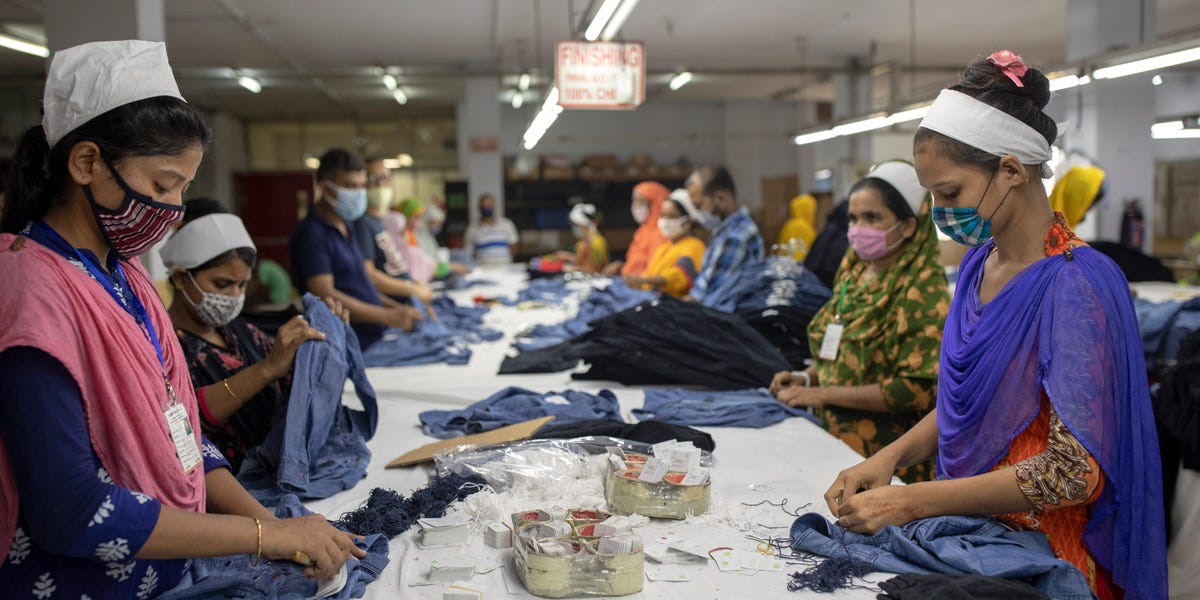


women make up over half of the garment sector workforce in Asia. They are disproportionately represented in low-wage jobs in the lower tiers of garment sector global supply chains. The report found that the average gender pay gap in the garment sector (in nine countries in Asia) is approximately 18 per cent. Worldwide, women in the garment sector are denied rights to maternity leave or childcare. They also face commonplace instances of intimidation, sexual abuse and harassment in workplaces as well as on the way to or from work.

Bangladesh Centre for Workers’ Solidarity campaigns for worker safety, fair wages and the right to labour unions.

Those involved in the campaign face risks, challenges and opportunities of being a human-rights defender but they feel it's worth it. In these factories issues such as unsafe working conditions, union-busting, insecure hours and wages, gender inequality, violence, and criminalisation are everywhere and justice needs to be sought. Everyone has a fundamental right to life and safety, Through collective action the campaigners believe, “change can come when workers fight together”. campaigning workers face tough times their voices criminalised,  fired and blacklisted just for raising their voice asking for a safe gender-based-violence-free workplace, and dignified wages.


children as young as 8 or 10 start working In the factories, working 100s of hours for a mere few dollars a month, on the feet all day for 10 hours or more, working in poor, dangerous and unhealthy conditions.

Covid-19 hit factories and therefore workers hard, brands just cancel their orders or deny to pay the bill that they would owe to the manufacturers, this directly impacted the workers. no work no pay. resulting in lack of money to buy food for themselves and their families.

This needs to be changed. And these changes can come when workers are united, when workers are fighting for their lives together one of the best tools for this is a union. Forming unions and joining with a union makes them united and strong, and their collective voice can bring the changes.

The unions are important because, in many cases, the laws of the country are not enforced. For example in Bangladesh there is a labour law, though it's not adequate or often enforced because there is a power collusion between business and politics.


 if there is a strong union in the factory, they can do the collective bargaining agreement with their respective factory management over the demands they have. And sometimes that agreement can be even beyond the law. for example living on poverty wages, but through the union agreement, if workers give a demand to receive a living wage, that can be discussed. 

Fashion Checkerhttps://fashionchecker.org

Union's are also important if women workers are willing to discuss gender-based violence during their collective bargaining agreement. It t can be discussed, and resolution can come to set up a committee in the factory and resolve all these problems and eliminate all the gender-based violence from the respective factories so that it would be a women-friendly workplace.

The campaigner workers sometimes face criminal charges, are often threatened, beaten, forced to fight .Being fired and blacklisted is very common.

When they defeated however, they still stand back up and fight did they start to win. Through a collective voice, through a union voice and union collective agreement, a change can become. A change is possible.

Clean Clothes Campaign: Amplifying worker voices in the garment and sportswear industry

Saturday, 9 April 2022

Fashion: textiles in Ghana


KENTE

Kente (Akan: kente or nwetoma; Ewe: kete; Dagbani: Chinchini) refers to a Ghanaian textile, made of handwoven cloth, strips of silk and cotton. Historically the fabric was worn in a toga-like fashion by royalty among ethnic groups such as the Ashanti and Ewe. It is also worn by queens, princesses and women of Dagbon.


 in the Ashanti region of Ghana, Kente cloth is a great status symbol, marking your wealth and, in the past, your office. Something to be worn on important occasions and by important people.

A typical Kente fabric is woven in narrow strips. Each strip contains a series of bands, designed in intricate, multicoloured, geometrical patterns, alternated by other bands of simple, linear designs in contrasting, co- ordinating colours for harmonious effect. 
Each pattern is named after a historical event or a person, or is connected with a proverb.

the weaving process:
the design determines the colours of the yarns that he has to put on the bobbin and, subsequently, on the wool.The process, is to put the warp thread into the heddles and  beater and work according to the design pattern.After putting the warp thread into the various heddles and beater, the whole thing is brought into a loom for the weaver to start to weave it.There are two sets of heddles. The first set is used in making patterns and the second set is used in being regular weaving, where no patterns are required. to make one strip is takes arounds  eight hours of hard work. 
the original Kente designs were black and white. The cotton used grown locally. The black and indigo colours were locally made using local available dyed colours. The weaver had no contact with the rest of the world, so he had no access to the variety of colours that we have today hence the colour choice, up until the development of the "Gold Coast" which also introduced not only colours but also silks.

With modernisation, there have been many changes In the past only black, red and golds were used, but nowadays more colours are available. colours may not always be exact but they are used in producing traditional designs in modern fashionable colour patterns, in order to make people attracted including metallic thread for a "party" look.

Adinkra

Adinkra is a printed fabric - hand-made and worn mainly for funerals, an important celebration in Ghana. Adinkra fabric is carefully printed in graphic symbols of geometric motifs, on a background of white, rust-brown, or black vegetable-dye fabric. Any one of the motifs, or any combination of them, could be arranged in narrative patterns to convey specific messages.
These messages may be expressed as a reflection on issues pertaining to beauty, morality or other higher values. 

The black dye for the cloth is produced from kuntun kruni - the roots from the kuntu plant. To make it ,twelve buckets of water are used to make one barrel with twenty-five strips of the roots put into it and stew for 2days. when you put in the white cloth first it looks like brown, but by two weeks’ time it will change into black, leaving it to seep and be dyed for two weeks, leaving it in the sun. When it dries you bring it back, and wet it again, and dry it again, repeating this process six times.  ‘Badie’, the hard bark of the tree found only in the Savannah areas is broken into pieces and soaked with water for twenty-four hours. The softened bark is pounded in a mortar and is used to produce the dye for stamping the symbols.Repeated boiling and filtering produces a concentrated solution.Out of forty-eight gallons only one gallon of the solution is produced.
The Adinkra stamps are carved from the wood CU stamps being of a gourd or calabash, by a professional carved designer and carver, such as, Joseph Kofi S/I Nsiah.


Kente is associated with important occasions, but it is linked especially with high social office and is more of a wealthy person’s status symbol, whereas Adinkra is associated with funerals and thus important but solemn occasions in the lives of everyone.

Kente is designed to be felt (‘beautiful’, like silk) as well as for appearance, it uses imported rayonsAdinkra is designed to be looked at and requires local supplies for the dyes.

Ways of making kente and adinkra have shifted and continue to shift.  kente weavers first used cotton and vegetable dyes, then bought silks from European traders, before beginning to use rayon. The most recent introduction is the use of lurex to achieve ‘glitter’. Vegetable dyes are used for adinkra, black and white or coloured, some cloths thave black-stamped designs on red and blue grounds

Kente is very time consuming to produce, with one strip of the best cloth taking at least a day to make with grades of skill (only 10% of workmen are able and willing to make some difficult designs due to time and skill needed. under the control of 1 man, taking even longer before as thread used to be homespun) 

Adinkra takes several weeks to make and involves the input of dyer, stamp carver, and printer in a collaborative process.

With kente the decisions and exact calculations take place right at the start, before the weaving begins. The design and colour choices must be thought out before warping up the loom, and the plan must then be steadily and accurately followed through with no changes.

Adinkra depends on a lengthy dyeing process (of six dippings) to obtain the depth and evenness of hue. It requires precision, speed, and decisiveness at the printing stage. Design activity is concentrated towards the end of the making process.

no matter which design buyer is acquiring skilful design and execution.

Wednesday, 20 May 2020

FASHION: Consumption as a social marker

After focusing on the fashion industry in its productive aspect, we should look at how consumption operates as a social determinant. 
An American anthropologist, particularly known for Stone Age Economics(1974), in which he equates primitive economics with an economy of abundance, Marshall Sahlins discusses the issue of consumption and production in the fourth chapter of Cultural and Practical Reason, published in 1976. On this occasion, he studies the American food preferences and clothing system.
Production as “cultural intention”
The essence of Marshall Sahlins’ thinking resides first in his criticism of a univocal conception of the process of the merchandise simply considered under its “pecuniary quantities (exchange value)”. Historical materialism, like orthodox political economy, would share a utilitarian vision, effectively omitting the “social organization of things”. According to this logic, the consumer would only think in terms of functionality. His choice would be made in a completely rational way on the most recent object logically benefiting from the latest technical improvements. It would be this rational quest that would qualify bourgeois material happiness. However, for Sahlins, human behavior would also be guided by other parameters: “men do not merely survive”, they survive in a “definite way”. Thus, there are several types of houses, which are as many ways to “consume” a house. This is precisely what leads him to define production as “cultural intention”, and to affirm that “the material process of physical existence is organized as a meaningful process of social being”, or that “production is a functional moment of a cultural structure”. He therefore outlines the project to provide a cultural explanation of production by studying the food preferences of Americans, before focusing on their clothing system.
Consumerism and bourgeois totemism
It is from this reflection on the “cultural intention of production” that Sahlins attempts to broaden the concept of “totemism” popularized by C. Lévi-Strauss in La Pensée sauvage (1962). Criticizing him for not having transposed it to the contemporary, the anthropologist postulates for the replacement of the “totemic operator” by “species and varieties of manufactured objects, which like totemic categories, have the power of making even the demarcation of their individual owners a procedure of social classification”. In the end, capitalist society would only be an extension of this “pensée sauvage”, but this time with exchange and consumption as means of social marking. The author here takes up J. Baudrillard’s reflections, considering consumption as an exchange of meanings (besides the exchange of material goods). Goods would present themselves as “object codes for the signification and valuation of persons and occasions, functions and situations”. 

The American clothing system
M. Sahlins proposes to study the American clothing system, “a veritable map of the cultural universe”, governed by “a set of rules for declining and combining classes of clothing-form so as to formulate the cultural categories”. His aim here is to achieve a “cultural account of production”. How do the physical characteristics of the clothing object transcribe into the social space? First, it notes the existence of categories of time and place with direct reference to specific situations or activities. Thus, a garment can be used for the day, evening, winter or sport. Similarly, it may denote a person’s social class, gender or age. In this way, the use of certain materials may be perceived as “womanly” (silk), while others may be more appropriately described as “masculine” (wool). Similarly, “blue jeans” will be considered as clothing restoring an opposition between teenagers and adults, joining in the process that of a worker/capitalist.
Sahlins then notices status categories. He uses on this occasion the distinction between ceremony and workmanship clothing highlighted by T. Veblen, namely the opposition between solemnity and formality on the one hand, and utility and good service on the other. From this, the rule of “ceremonial correspondence” is established, defining the opposition between ceremonial and professional categories, applicable to any social class. In other words, for Sahlins, the “ceremony” garment would always be different from the “workmanship” garment. The evening tuxedo would be more formal than the dark work suit, itself more formal than the sports outfit, itself more formal than pajamas. He also notes the rule of “ceremonial exaggeration”, according to which the tuxedo will be more stylized than a suit, itself more stylized than the interior garment.

Finally, Sahlins tries to determine the oppositions inherent to the material characteristics of clothing objects. In texture, line and colour, he looks for elements that could mean social differences. In terms of texture, for example, the heavy would be opposed to the light, the coarse to the fine, the crunchy to the soft, all parameters signifying an individual’s age, sex, activity, class. For instance, a light, thin and soft garment would be more appropriate for Sahlins as a “feminine” garment. Similarly, clothing lines and colors would provide us with many clues about an individual’s social state. He cites, for example, a study by Maitland Graves in which the vertical line (severity, austerity, dignity) would be opposed to the horizontal line (calm, passivity, quietness).
Without spending more time on the categories drawn by Sahlins, let us retain the way he tries to systematize American clothing practices to find social meanings. While we will not share all its categories nowadays, as it is increasingly difficult to distinguish, for example, between certain “male” and “female” clothing, it must be noted that clothing is indeed a social marker, and that its consumption/production is nonetheless significant.
Consumption and identity construction
French philosopher J.P. Sartre published Being and Nothingness in 1943. Often referred to as “phenomenological ontology”, this essay invites us to question ourselves on the being of Man and to describe its fundamental structures. Composed of four parts, it is chapter II “Doing and Having” of the fourth part “Having, Doing and Being” that will interest us here. After having outlined his project of existential psychoanalysis, based, unlike Freudian psychoanalysis, on consciousness and aiming to grasp the totality of the human being through a decoding of the empirical behaviors, Sartre focuses on the important question of possession, the link between doing, having and being.

After studying the “doing”, the philosopher comes to the question of “having”. “What is meant by “to appropriate”? Or if you prefer, what do we understand by possessing an object?”, in other words, how to define possession? He proposes several key characteristics.
Possession as use?
If using an object can indeed be a sign of its possession, it cannot be irreducible to the question of use. Someone can use a cup of coffee in a brewery without being the owner of the cup. In the clothing industry, an individual can rent an outfit without owning it. Similarly, the right of destruction cannot define possession. A man may own his dog without the right to kill him, otherwise he may be concerned about the law or animal welfare associations. Possession and appropriation, in other words possession and the right of possession, must be separated. A man can indeed possess an object without appropriating it, in other words without “making it his own”, and appropriate it without possessing it. Hence Sartre’s refutation of the Proudhonian equivalence between ownership and theft (Proudhon said: “ownership is theft”), since ownership can very well be the result of theft without affecting the relationship between the thief and his new possession.
Possession as being
The object cannot therefore be defined by a total exteriority to its owner. We speak of a “possessed” man to mean that he no longer belongs to himself, that he belongs to others, that he is someone else. Sartre mentions the existence of primitive societies where people are buried with their property, where these two entities (the person and its belonging) are inseparable. Even today, objects that belonged to a dead person may still be placed in his grave to mark their indissoluble connection. The author also evokes haunted houses belonging in a sense, even after their death, still to their owners. Hence Sartre’s remark: “to be possessed means to be for someone”, which means that “the bond of possession is an internal bond of being”, that “having” finally amounts to “being”, that there is finally an equivalence what is possessed and who is possessing. The exhibition of old celebrity clothes is precisely a similar case: a jacket that once owned Jim Morrison still seems to have his memory in it.
Possession as a union
In addition, Sartre notes that the object refers to “permanence”, “non-temporality”, “substantiality” (it exists in itself) when the possessor is completely dependent on it. “To possess is to be united with the object possessed in the form of appropriation; to wish to possess is to wish to be united to an object in this relationship”. The desire to have is the same as the desire to be. I do not only want jeans, I want to unite with them to form a single entity. I am therefore composed of the self and the not-self (jeans). Thus, the person is in a way the purpose of the object he owns. The original notion of luxury that haute couture exemplifies, also testifies to this. A dress is made for me, so the dress has no other purpose, no other possible purpose than to be worn by me.
Possession as a continuous creation
For Sartre, the act of purchase also amounts to an act of creation. In fact, the wearer gives meaning to the garment purchased. He contextualizes it, actualizes it in the middle of other clothes, etc. My jeans are not just any jeans, it’s the way I use them. My jeans are the way I use them, the way I interact with them (personalization, how to roll them up, etc.). The object cannot make sense without my act of use, without a relationship of appropriation. But what I create for Sartre is “me”. He notes that “the totality of my possessions reflects the totality of my being. I am what I have. It is I myself which I touch in this cup, in this trinket”.
Levi's, Spring Bottom Pant, 1890's
Also, the relationship of possession cannot be anything other than a continuous creation. If the object is placed under my dependence, there is no less of it by itself. The object therefore exists without me (in itself) and by me. A certain univocity of the relationship is found here. It is still my usage that defines possession. Jeans are irrelevant if they are simply placed on a hanger. To own them, I have to wear them, wear them out, patch them, etc. Sartre notices the alienation of the possessor, who cannot exist outside the possessed object. The object belongs to me but it remains independent, or “originally in itself”.
The infinity of possession
The relationship to an individual’s possession is thus defined as “symbolic and ideal”. The consumption of a possession is continuous. It seems impossible for Sartre to achieve possession all at once. He takes the example of the bicycle. If it only takes one act of purchase to own it, this act is accompanied by multiple gestures: I touch it, contemplate it, then drive with it to get the bread, before going on a tour of France, etc. In the case of buying a jacket, I can simply contemplate it on a hanger, but I very quickly have to touch it, to wear it, otherwise I won’t appropriate it. Thus its use remains uninterrupted. And since I’m going to die, I can’t help but exhaust his consumption. 
But destruction and deterioration are also an appropriation. I can’t have an object in itself, I destroy it somehow to make it my own. I wear out my clothes, I alter and destroy them little by little, but at the same time I take them over. The deterioration can therefore sometimes be synonymous with enjoyment, especially in the clothing industry. This gives prestige to certain raw jeans that are worn, perforated, frayed, etc. The object is then marked by consumption, by appropriation, and therefore by possession. Sartre draws a parallel with the elegance of G. Brummel and his hatred of the new.

“To possess the world”
Finally, the philosopher focuses on the meaning of possession: “What then is it which we seek to appropriate?” To possess is to want to appropriate at the abstract level what he calls the “the mode of being of an object as the actual being of this object”, i.e. its existence as a solitary object devoid of my use, but also, at the empirical level, its extensions, i.e. the possibility of use that I can make of it. Owning jeans is both owning jeans, in that it belongs to a specific category of trousers (jeans are not formal pants), but also owning their possibilities of use (wearing it, etc.). Basically, possession is defined as the synthesis between these two particularities. “Each possessed object which raises itself on the foundation of the world, manifests the entire world (…). To appropriate this object is then to appropriate the world symbolically.” Sartre mentions his experience with tobacco, and his fear of losing the flavor of events such as a dinner or a show, by quitting smoking. Finally, the act of smoking was for him to achieve a destructive appropriation function of tobacco, meaning an appropriate destruction of the whole world. Consuming an object would therefore, according to Sartre, amount to consuming it individually, but also to consuming the world. “To possess is to wish to possess the world across a particular object.”
To conclude, if desire refers at the same time to the desire to be and the desire to have, these two are distinct, although they are inseparable in daily life. The first is related to for-itself, when “the desire to have aims at the for-itself on, in and through the world”. 
Consumption choices therefore reflect a certain way of being in the world. The purchase of one garment among others is not insignificant, translating “symbolically to our perception a certain way which being has of giving itself”.

Fashion business models

 at an industry level, we can see that fashion is a sector that is a kind of epitome of globalization. Every country in the world is more or less positioned as a customer or supplier for other countries, and the integration of countries is very strong in the sector. This is due to the fact that, in fashion, you have quite low technical barriers to entry, and very low cost countries such as China, Vietnam, Bangladesh, can position themselves in the sector quite easily. Because they have a lot of work force also, and since it's a quite labor intensive industry, they have been able to reach a very strong position in this sector during the last few years.
the geography of the sector evolves a lot due to the evolution also of the global players that have a very global strategy both in terms of sourcing and distribution. So, in fact, the landscape evolves very fast. At the company level, one can think that it's very easy to enter in a fashion business. Since the cost of entry is quite low, with some money you can easily produce a collection or create your shop, online for instance. You can believe that there are low barriers to entry in this sector. In fact, it's quite wrong to think that, since you have both economic barriers to entry, and symbolic. For instance, if you think about the mass market business, it's really a lot about being competitive price-wise. So, to do that and to achieve this kind of competitiveness, you need to produce a certain volume and you need to invest a lot at the beginning to attain this kind of competitiveness. If you think of other kinds of positioning, in the luxury creative field for instance, you have other kinds of barriers to entry which are more about symbolic. So you need, in fact, to position your brand and to send to the market signals that your proposition is credible and you have very strong creative potential. To do that, you have to work with certain companies, you have to be recognized by certain bodies. In fact you don't choose to position yourself in the sector, you are accepted as part of it, but it's very hard to enter. At the end of the day, customers will pay for the brand and the stronger the brand is, the bigger the mark-up is. If you're a very emerging brand, if you buy a piece of clothes at 100 euros, you will be able to sell it at let's say 200. If you're a very strong luxury brand, you will be able to sell it much more, at a much higher price than that. It's really highly connected to the strengths of the brand.That's why companies develop strategies to both, protect and expand, the strength of the brand, through their search for legitimacy, through the fact that they produce lots of creation, that are not meant to be sold, but just to testify of the creative strength of the brand. Selective distribution is something key for creative and luxury brands, because they want to select the people that are allowed to sell their products. Again, in this idea of creating a brand asset, you have lots of very concrete strategies that are set up by companies.

During the last 30 years, we've seen the growth, amazing growth, of retail chains, that have changed the landscape in the fashion sector in every country in the world, both in the US, in Europe, in Asia. These kinds of players have achieved very strong performances due to a unique business model which helped them to gain market shares, against more traditional forms of businesses, such as independent retailers or traditional brands. In fact, they control a big part of the supply chain, and they also search a lot for competitiveness through a global sourcing, and through the fact that they are very concentrated, and they are able to have a very strong bargaining power against their partners.  they achieve this kind of performance through this kind of tools, of economic tools, and in fact if you take a look at the market share in terms of players today, retail chains represent roughly between 30 and 50 percent of the market. There is a big concern today regarding sustainability, regarding the fact that this model that has been very powerful during the last decades is sustainable in long term, and that customers are still willing to pay the cost of this organization. And moreover, with the digital revolution, we see more agile and more modern business model starting to emerge. That's potentially the new business model, the new successful business model that is appearing today.

There is a huge diversity in terms of business models. Historically, it was easier because you had some companies who were very specialized in creation, others in manufacturing, others in retailing. And today, we can say that you have many models that combine these different elements in their proper way. You can have brands that are today ensuring directly in the retail scene, and don't rely on multi-brand or department stores. You have retailers that integrate the creative process and sometimes even manufacturing. So, what we can say is, in general, the more you control the supply chain, the stronger you are. If you are a digital native vertical brand, if you are a retailer, it's very interesting to control the major part of the process. There are lots of new designers, new brands emerging every year, every season, so to gain this visibility which is, of course, something you have to achieve, it's quite complex. You have both challenges in terms of visibility, of market access, and also in the upstream field your ability to be produced. Because there is, again, a lot of competition to access manufacturers. They require minimum quantities to produce.  if you're a small player, in general, you are not served the first, it's the biggest brands, biggest players that are produced earlier than you, which is very tough in the field of fashion because if you arrive on the market later than the others, you have a good chance that your collection will not work because others will have been able to sell earlier than you. For instance, for creative labels, it's very complex because they show their creation very early in the season, and they sell very late.In terms of distribution and communication you need to take a look at what's happening in retail, in the press, the traditional partners for emerging brands which were multi-brand formats, such as independent retailers, or department stores, are struggling, so they have less and less access to this kind of partners. And in terms of press also, the support for emerging designers is more and more complex. The press is facing major changes too, so lots of brands today choose to talk directly to the customer through social networks, for instance, rather than rely on traditional PR strategies. The digital revolution adds a new chapter to globalization. It's something that leads to more transparency among the processes across the world, that helps you to reach new categories of customers. It's something that, again, increases the globalization of the sector. And what we see, as something very potentially very strong for newcomers, is their ability to use the data they can gather through the different digital tools they use, and to be more agile today than they were in the past, to be able to reply to all the market changes we are observing at a faster and faster pace. We see that, for instance, the model that we knew of fast fashion retailer, is maybe, can be beaten by new models, which will be able to have the same probably, the same ability to reply to trends, or to anticipate them, but at a lower social cost for instance, because there will be more agile and more able to track all that's happening in the supply chain for them. Potentially, we can see new players emerging which will combine the two elements in terms of sustainability, but also the taste for customers for new products and creation.

Thursday, 14 May 2020

Avant garde fashion and its political role

Avant garde fashion and its political role


Caroline Evans is professor of history and fashion theory at the Central Saint Martins School in London and published Fashion at the edge in 2003. She proposes a reflection on the work of designers such as Rei Kawakubo, Yohji Yamamoto, Martin Margiela or Viktor&Rolf, whom she defines as “experimental”, opposed to commercial, “conventional or generalist” fashion.
If the latter appears as “an ingredient of the process of civilization” (N. Elias), the “avant-garde” fashion would rather reveal a “neurotic symptom”, a resurgence of “repressed desires and anxieties” of the late 20th century. Often also referred to as “conceptual”, “anti-fashion”, or related to the notion of “deconstruction” (see the writings of Y. Kawamura or B. English), the work of Issey Miyake, Rei Kawakubo, Yohji Yamamoto, Martin Margiela, the “Antwerp Six”, or Hussein Chalayan and Helmut Lang, is very important if one chooses to focus on the political role of fashion. Finally, let us look at how their creations take a critical position through a study of the second generation of Japanese designers in Paris (Rei Kawakubo, Yohji Yamamoto), and Martin Margiela’s work.
The Japanese and the questioning of Western conventions
Respectively born in 1942 and 1943, Rei Kawakubo and Yohji Yamomoto both grew up in the context of post-war Japanese austerity, before presenting a joint collection in 1981 in Paris. Worn, torn, with impressive volumes, the clothes are associated by some critics with a “post-Hiroshima” aesthetic, an “aesthetic of poverty” (Harold Koda, American Vogue, April 1983). They specifically target two foundations of Western fashion:
1. A reassessment of the notion of perfection


First of all, they propose a reassessment of the notion of perfection. Yohji Yamomoto wants to report on the effects of time on his clothes. This is how he evokes it:
“In his lifetime, a human being ages. Similarly, textiles, which is a living material, is getting older. If they are allowed to age for a year or two, the fibres naturally tighten up and the charm of the fabric increases (…) That’s why vintage clothes sometimes make me feel fiercely jealous (…) This paradox of design is in my opinion an essential question, that I am constantly trying to solve”
To do this, he operates various processes of washing, crumpling, raw cutting. The collections of Winter 1981-1982, Summer 1984, or Winter 1984-1985 illustrate the quest for imperfection: while the first one plays with raw wool, rustic knits, the second one is inspired by photographs of August Sander’s anonymous farmers, and the last one features clothes with visible seams, coats resembling blankets, in addition to numerous raw cuts.
Rei Kawakubo, on the other hand, is looking for something new in accident. For this reason, she develops a special relationship with the machines that her team disrupts by sometimes removing a nut or computer program to vary the irregularities. But she also tries to mimic the patina on her clothes as she did in the summer of 1983. 
This re-evaluation of the notion of perfection will also take shape in their use of asymmetry. Rei Kawakubo thus diverts the garment from its primary function. Her tunics were transformed into shawls in 1981, the sleeves and buttons removed in March 1983. Yohji Yamamoto extends sleeves, shortens pants, lowers buttons, or moves pockets (Winter 1985-1986).
2. Rethinking the relationship between clothing and gender
The two designers rethink the relationship between clothing and gender. The choice of the name “Comme des Garçons” appears here as a desire to free women from clothing conventions. Rei Kawakubo develops a hostility towards the “body conscious”, no more considering clothing as intended to enhance the female forms. The Autumn-Winter 1983-1984 show is an illustration: the woman’s body is cancelled, her hips, waist, buttocks, and hair disappearing under the layers of fabric.
Yohji Yamamoto criticizes the virility that he defines as an instrument of control. He aims at deconstructing the Western male costume inherited from Savile Row. To do this, it removes or rounds off traditionally padded shoulders, moves buttons or pockets, exaggerates hems, and shortens the length of trousers.


Martin Margiela, “the ethics of style” (O. Zahm, 1994)
Launching his first collection in 1988, Martin Margiela develops general reflection on the foundations of his discipline, in particular by criticizing the notion of “new” in fashion, as well as its “spectacular” character.
1. Rethinking the time of fashion
Defined by the Situationist International (SI) as “the reuse in a new unit of pre-existing artistic elements”, the technique of “detournement” is central to capture the first aspect of Martin Margiela’s work. In this way, he introduces a critique of perpetual change by diverting old clothes and reusing some previously used materials in his craft collection. Dozens of old sandals were dedicated to making a top for Summer 2006, several old scarves for a long skirt (Summer 1992), or several military socks for a sweater (Winter 1992).
Similarly, its Replica collections (lines 4 and 14, launched in 2003 and 2004) aim to reproduce anonymous and unscratched old clothes from different historical periods. A doctor’s jacket from the 1920s was resurrected for Summer 2005, like a French costume jacket from the 1970s or an old aviator’s jacket for Winter 2005-2006. 
Martin Margiela therefore rethinks the relationship between fashion and time. It is no longer a question of running away from it in a cyclical and continuous change, but of using it as a language in its own right.
2. A critique of “fashion spectacle”
Then, the Belgian designer makes a formidable criticism of the spectacular nature of fashion. 
His propensity to dissolve into the collective contrasts radically with the cult of the individual in the 1980s fashion world, magnified by his mentor J.P. Gaultier. Anonymity appears to be the basis of his project. He does not resolve to make any public appearances, limits interviews, and leaves his labels blank until 1997. This relationship to anonymity is also visible during collection presentations. The faces of the models are covered with masks without holes in the AW 1995-1996, Winter 1998, half painted for Winter 1996-1997, or hidden under pure fringes in Winter 2000-2001.

Priority is also sometimes given to her team, as in Summer 1998, or 1999, when she is the one who presents herself to the public.
As the second generation of Japanese, Martin Margiela is a strong critic of fashion. If the first ones aimed at challenging the Western conception of clothing around a reevaluation of the notion of perfection and a questioning of a gendered conception of the costume, the Belgian designer will defend a clothing archaeology, as well as a criticism of “the fashion spectacle”.
By studying these various works, we can clearly see to what extent fashion can also be used as a critical support.

Tuesday, 12 May 2020

where do fashions come from?

where do fashions come from?

According to Adam Smith, the founding father of the modern economic science and liberalism, 
"It is from our disposition to admire, and consequently to imitate, the rich and the great, that they are enabled to set, or to lead what is called the fashion. Their dress is the fashionable dress; the language of their conversation, the fashionable style; their air and deportment, the fashionable behaviour. Even their vices and follies are fashionable; and the greater part of men are proud to imitate and resemble them in the very qualities which dishonour and disgrace them".

This theory is echoed by the French sociologist Pierre Bourdieu in Distinction (1979), in which he states that aesthetic preferences are "class markers", which reflect the possession of resources that are not only economical but also cultural (that explains why the "nouveaux riches" always have as much trouble as the underprivileged to understand the principles of "good taste"). 

While also echoing Adam Smith’s Trickle-down theory, Georg Simmel extends it by explaining the elite’s motivation to constantly shift towards new styles: fashion’s continuous reform comes, from the ruling classes’ will to separate themselves from the masses. Moreover, a symmetric dynamic can be found at the heart of the perpetual renewal of fashion, in the imitation of ruling classes’ clothing habits by inferior social categories, forcing the elite to adopt new styles in order to appear new again. 
This vision of fashion rests on an assumption that is nowadays widely contradicted, whereby the elites determine the shifts in fashion preferences. We can easily find examples of fashion movements which follow the opposite trajectory, going bottom up.


Blumer says that fashion movements have two specific moments of manifestation: 
*first, when the collections are presented, through fashion shows and showrooms displaying the entirety of a brand’s collection, 
*then, downstream of this presentation, when the buyers from the stores that distribute the collection make their selection. 


The fashion moments are not the result of a differentiation mechanism whose goal is to renew styles as quickly as possible in order to distinguish some parts of the social entity, but the consequence of the selection, by an expert group, of a determined amount of shapes, colors, and materials. Blumer argues that the "expert group" composed by fashion designers and buyers both present an impressive consistency of preferences, which he finds responsible for the creation of fashion movements, or, in other words, of clothing mimicry: as consumers in a specific society have access to a limited amount of styles that have been preselected by an expert group with consistent tastes, it is logical that they all dress the same. What is left to explain are the criteria according to which this double selection is made, and why it appears to be so homogenous.

Blumer excludes the idea of coordination: the "caste" of fashion designers is "secret" and competitive, as is the buyers’. Designers converge towards the same ensemble of choices, each season because they share three categories of preoccupations from which they draw their inspirations: 
the first being the history of costume, the second the immediate clothing habits, and the third the contemporary artistic production. Taking inspiration from past styles is a recurring habit of fashion designers, who were the first to read historic books regarding the story of costume published in the second part of the 19th century: traditional clothing, as well as the creations of the past decades, provides designers with an impressive catalog of images. Fashion designers have also in mind the clothing habits of their immediate contemporaries. When Blumer’s article is published, fashion has opened to ready-to-wear, and as a result, designers have to pay more and more attention to "street fashion". Here again, their job is to reinterpret, through a series of variations, outfits that they witnessed in vivo. But the most fundamental common point between designers, and, for Blumer, the main reason for the similarity of their taste lies in their "intimate familiarity with the most recent expressions of modernity". As they "engage in translating themes from these areas and media into dress designs", they establish a necessary proximity with the other fields of the contemporary creation: their work becomes the translation, in clothing language, of ideas which appeared elsewhere.

It is even more true at an age where fashion is liberated from the academism of Haute couture, mainly through the development of ready-to-wear and the emergence of youth culture. Blue jeans, for instance, are one of the most famous examples illustrating this phenomenon: originally worn by American workers of the 19th century, they are nowadays a worldwide popular uniform, available at all of society’s sections. So we need to find another candidate to explain the origin of fashion "trends". 

Herbert Blumer is one of the most famous opponents to Simmel and Smith’s common theory. He argues that the elites themselves undergo the influence of a universal drive towards novelty. For Blumer, "fashions", in the sense of clothing shifts, are the direct result of specific interactions between individuals who share similar interests and perceptions.It is the observation of "fashion stakeholders", as an "environment", and the understanding of its stakeholders subjective motivations, of their perception system as well as their tastes, that allow us to understand the origin of the convergence of preferences phenomenon.
Eventually, Blumer describes fashion creation as a "derivative" form of creation: its substance comes simultaneously from fashion history, contemporary clothing habits, and recent developments in other arts. According to Blumer, the second selection group, the buyers, doesn't share the designers’ specific choices, yet they share everything else that determines their choices: they read the same magazines, go to the same cities, restaurants, and parties, see the same movies, and take passionately interest in fashion’s twists and turns, both on the catwalk and in the streets. They are part of the same "remarkably common world of intense stimulation": their perceptual environment is identical. Based on this set of intellectual and sensorial stimulations, they anticipate the shifts of fashions and customer’s tastes: it is no wonder, thus, that their anticipations stay consistent. Blumer draws, from these empiric considerations, a general theory about the origin of fashion movements. 
According to him, "The fashion mechanism appears not in response to a need of class differentiation and class emulation but in response to a wish to be in fashion, to be abreast of what has good standing, to express new tastes which are emerging in a changing world". In other words, fashions are not the result of the preferences of the ruling classes, but the consequence of an expert selection determined by minds which are deeply aware of the style novelties: fashion designers and buyers.
Yet, Blumers’ argumentation is not faultless: the data drawn from his inquiry doesn’t seem satisfactory to accredit his general conclusions. Blumer makes an additional implicit hypothesis, which doesn’t rely on his observations, whereby the desire for novelty would be socially or anthropologically prior to the desire of domination or differentiation from other individuals. 
In other words, even if Blumer convincgly shows that fashion movements are not driven by elites, he doesn’t bring any decisive argument to the table in favor of the presence of a pre-existing, independent "fashion desire". We can also suppose that novelty is a mere instrument in order to achieve social distinction: as we observe, following Blumer, that fashions are the result of a collegial decision between specialists, we can also notice that it remains a device of class-affirmation or self-affirmation, as it is the expression of a superior economic or cultural capital. To be fashionable remains expensive, on the intellectual level as well as on the economic level.