Monday, 2 May 2022

FASHION: POWER & CHANGE

 There is no blueprint for transforming social injustice. The interaction between society, nature and psychology, and fashion and injustice is complex. Complexity doesn’t lend itself easily to straightforward change. Some suggests there are three dimensions of change, which are mutually reinforcing and equally necessary: holding actions, life sustaining systems and practices, and shifts in consciousness.

Sustainable Fashion Glossary

1. Holding actions are holding back or slowing down injustice or environmental harm - making things less bad. Holding actions can also be about caring for those that have been harmed, or safeguarding communities from injustice. This could take many forms, such as removing our support for behaviours or products we believe are the problem; or joining campaigns, legal proceedings or protests. It might take the form of laws such as the growing number of modern slavery acts, or the payment of compensation for Rana Plaza survivors. Or it might be about staging protests to draw attention to injustice regarding diversity and inclusion in the fashion industry. Holding actions are essential, but are not enough to stop injustice. This is because as one injustice is challenged, other people will be harmed elsewhere.

2. Life sustaining systems and practices are about creative, new ways of being and doing, so that life flourishes, rather than focusing on the prevention of social injustice. The call is to replace or transform the systems that cause harm. This might be new business models that create social relationships between people, such as the LEEDS Community Clothes Exchange that aims to develop community spirit through community clothes swapping events. Making for Change is another example. This project involves a fully equipped manufacturing unit inside HMP Downview. It offers a safe space for women prisoners to gain industry-recognised qualifications. It provides real work experience to utilise the women’s skills in the manufacturing environment by producing client orders.

3. Shifts in consciousness relates to new ways of thinking and seeing our relationship with ourselves, with nature and with other people, as the foundation for social and environmental justice. It is also about strengthening compassion and our sense of belonging, so that we are nourished and protected from burnout.In the past, changing the self and changing the world were often regarded as separate endeavours and viewed in either-or terms but they are in fact t mutually reinforcing and essential to one another.

another view is that of Duncan Green, in his book How Change Happens. He lays out four ways of thinking, feeling or working towards change:

  1. Curiosity - study the history; “learn to dance with the system”.
  2. Humility - embrace uncertainty/ambiguity.
  3. Reflexivity - be conscious of your own role, prejudices and power.
  4. Include multiple perspectives and unusual suspects - be open to different ways of seeing the world.

Values and behaviours

“Fashion and Social Justice are interwoven… Fashion is a statement. It is empowerment. It is agency” - Amanda Nguyen

What change is needed to address social injustice?

Values are the principles that help you to decide what is right and wrong, and how to act in various situations. They can underpin an action. They can be deemed to be positive - diversity, inclusion, equity. They can be seen as negative - misogyny, racism, transphobia. 

Behaviours are the actions that play out as a result of the underpinning values. In the context of fashion and social justice, this might include collaboration with others, paying a living wage, access to trade unions for all employees, diverse and inclusive working practices. Or it could be allowing unsafe working environments, the polluting of a local river, contribution to the destruction of a local ecosystem, discrimination of employees based on gender, race or ethnicity.


Where does the power lie to challenge social injustice in fashion?

At times, the scale and intensity of social injustice in fashion can feel daunting, perhaps even disempowering. This is experienced by individuals and groups in many different ways according to how patriarchal, colonial, capitalist and homophobic relations have shaped experiences.

One way to gain power to challenge social injustice in fashion is by people working together to bring change for a common cause. We can gain power by joining with others, whether as workers, citizens, consumers, people in a shared community, survivors and more. This is about power with, rather than power over.

https://creaworld.org/wp-content/uploads/2020/07/All-About-Power.pdf

Workers have a specific type of collective activism in the form of trade unions. Workers may be vulnerable to being sacked or blacklisted if they stand up to employers by themselves. Therefore, trade unions are a way to give a collective voice to workers. Other forms of collective activism include campaigns and social movements, cooperative businesses, local geographic communities, online communities and organisations.

https://www.fashionrevolution.org/why-unions-matter-in-the-garment-industry/

Working with people can nourish and inspire. There is a chance to share the workload, vulnerability and emotional pressure. Ideas and responsibilities can be shared, and different skills can be contributed. Power increases when we join together and become less vulnerable. By acting with others, we have the power to create more change than we can achieve alone. Think back to earlier this week and our discussion about change dimensions. Working in this way is what we are aiming for when we are nurturing a shift in consciousness. It can be more about the process than about the outcome.

https://www.powercube.net


Governments & Fashion

Injustice in fashion can be challenged by calling on governments to prevent harm, for instance by challenging them to create new fashion practices that mitigate or avoid social injustice.

Government regulation and legislation

Governments can inhibit social justice and even perpetrate injustice, but they also have the power to nurture and create social justice.

Governments introduce legislation that can hold people and companies accountable in court for their behaviour. For example, some countries have anti-discrimination laws that make it illegal to discriminate on the grounds of certain characteristics such as disability, race or gender.

Workers’ rights legislation is far-reaching. Typically, garment producing countries have a range of laws relating to workers’ rights​. However, these rights are frequently violated and trade union activists are often persecuted, as Kalpona discussed in her podcast earlier this week. Many countries have environmental justice legislation.

The challenge is in the implementation of these laws. They are often violated by brands and retailers that are focused on keeping labour costs low, and by countries focusing on attracting foreign investment. Another challenge is that it is difficult to hold a company accountable for its operations in other countries, though there are some examples of legislation such as the US law blocking imports from Xinjiang in China relating to forced labour.

Most garment-producing countries have some limits on basic freedoms and rights, civil society and protest. Some states actively repress critical opposition, while others passively fail to enforce existing laws. This includes censorship, intimidation and detention of activists and the suppression of protest. In 2021, The International Trade Union Confederation (ITUC) reported that the garment manufacturing hubs of Bangladesh, Brazil, Honduras, Myanmar, the Philippines and Turkey were among the top ten worst countries for workers. The ITUC also found incidents of harassment, violence and repression, as well as failure to enforce human rights laws and guarantee human and worker rights, across garment-producing countries.

https://www.vogue.co.uk/fashion/article/green-legislation-fashion

Intergovernmental organisations

Intergovernmental organisations have the power to introduce guidelines and affect social norms regarding the behaviour of both companies and governments. The International Labour Organization is a United Nations body that brings together employers, workers and governments to set Conventions on labour rights. Many governments have ratified these Conventions, which means they commit to introduce them into their own laws.

One influential set of guidelines relating to workers’ rights are the United Nation’s 2011 Guiding Principles on Business and Human Rights which set out the duty of governments to protect human rights, the responsibility of states to respect human rights and the state responsibility to give those affected access to remedy. The guidelines influenced the development of work around mandatory human rights and environmental due diligence (mHREDD), which is generally understood as a process with which companies can efficiently identify, prevent, mitigate and account for the negative impacts of their activities or those of their subsidiaries, subcontractors, and suppliers. Some aspects of mHREDD have already been incorporated into some countries’ legal frameworks, notably the French Duty of Vigilance Law. However, there is a long way to go to make this mandatory across all countries.

The challenge for intergovernmental organisations is that they rarely have the ability to hold individuals or companies accountable in courts for injustices.

https://www.voguebusiness.com/sustainability/californias-garment-labour-law-the-global-implications

Calling for change and social justice

Networks and organisations that are using legislation or calling for governments to act to address social justice include, but are not limited to:

Human Rights Watch

ITUC Global Rights Index

Civicus

International Labour Organization

Client Earth

African Coalition for Corporate Accountability

European Coalition for Corporate Justice


https://corporatejustice.org/priorities/


Fashion companies are directly implicated in social injustice.

Just a small number of companies, mostly owned by a small number of white men, are directly implicated in fashion injustice. Many of those experiencing social injustice through fashion are young women and communities of colour. This is a form of power over.

It may feel that companies are the ones with the power to make meaningful change. Corporate social responsibility (CSR) is the general name given to company activities to address social and environmental issues. This takes many forms.

Many fashion companies engage in fashion diversity initiatives. These might relate to their employees, such as setting diversity-related hiring and retention goals, training, mentoring and outreach. Some fashion companies have also taken steps to address diversity regarding ideals of beauty or aesthetics and for the health of models. Other fashion companies address diversity from the perspective of product design.

Some companies have workers’ rights CSR programmes that often involve social audits and transparent supply chains in efforts to address workers’ rights violations. However, the Clean Clothes Campaign presents evidence in its 2019 Fig Leaf for Fashion report to show how the “social audit industry has failed spectacularly in its proffered mission of protecting workers’ safety and improving working conditions. Instead, it has protected the image and reputation of brands and their business models, while standing in the way of more effective models that include mandatory transparency and binding commitments to remediation”.

Other companies use CSR teams and strategies to focus on addressing their links to environmental injustices through supply chain transparency or collaboration with suppliers and third-party NGOs.

The challenge with CSR initiatives is that they are voluntary, and not state enforced. This means that it is up to the company to determine the resources they invest in these activities. Companies can also use CSR to give the impression they are addressing more social justice issues than they really are. This practice is known as clean-washing.

Small- and medium-sized enterprises, or SMEs, are businesses that typically have fewer than 250 employees. The businesses listed below implement various CSR initiatives, seeking to address social justice through their business activities:

  • Top Manta: Fashion cooperative and brand for social justice launched by Barcelona’s street vendors.
  • Yala: Jewellery brand working directly with Kenyan artisans to create small-batch collections.
  • Adish: Fashion brand with mission to bridge the cultural gap between Israel and Palestine, inspiring positive change in the process.
  • Tamay and Me: Brand making designs in partnership with communities in north Vietnam. Their aim is to help women to earn a sustainable living and to maintain their textile heritage.
  • I was a Sari: Indian social enterprise selling upcycled products such as contemporary ready-to-wear and accessories made from saris.
  • People Tree: Fair trade fashion brand specialising in the use of organic materials.
  • A range of further examples can be found on the Fostering Sustainable Practices Hub.


FASHION: Social injustice in focus

 Fashion is both a reflection of and a catalyst for social change, and can play a crucial role in social justice. Social justice in fashion considers fair distribution of resources, the elimination of institutionalised domination and oppression, and the consequences of fashion decisions made in one place on another, and by one generation over those yet to be born.


The story of fashion and the story of the many fashions that make up our lives stem from a variety of influences and also personal references. Culture also plays a huge role, for some more than others. our fashion developed against a backdrop of varied street styles, music influences, and contemporary fashion scenes. some, develop a taste in multiple styles of fashion and clothing influenced by varied Western street styles alongside other culture diaspora styles, too. for example British Indians. 

So what might an intersectional approach to fashion look like? How might fashion centre the stories of fashion beyond Europe and of the producers alongside designers?what do we know about the work of design activists and movements that challenge inequalities in fashion, such as unfair labour practises and cultural appropriation, as a way for students to reimagine fashion. This approach leads to questions of ethics, social justice, accountability, appropriation, indigenization, and decolonization.

Such an approach echoes what theorist Arturo Escobar calls a design for the pluriverse. The term pluriverse, originally used by the Zapatistas, the Mexican revolutionary political and militant group, envisions a decolonial political world in which many worlds coexist and thus destabilises the concept of universality that has historically justified processes of colonial domination. The notion of the pluriverse acknowledges the entanglements and interconnectedness between different ways of being in the world, and Escobar argues is a way to regenerate people's spaces, their cultures and communities, and to reclaim the commons.

So, what's more fashionable, London's Bond Street or  for example Ealing Road, home to South Asian fashions in West London? The question is used as prompt to explore examples of marginalised forms of fashion practise that originate from the global South and show alternative counter-hegemonic ways of making fashion. While both areas have stalls with high-end luxury fashions, the fashions are very different. In Ealing Road, saris, a pre-colonial garment in the form of unstitched cloth, dominates the storefronts.

These discussions also open space to discuss more sustainable and social-justice-oriented ways of making fashion, such as the Sari for Change brand that trains low-income communities to recycle saris, to historical examples, such as the London-based campaign group Sari Squad, a group of women, mainly of South Asian origin, who wore saris as a form of visible protest against far-right racist groups in the UK in the 1980s. 

This can lead us to question how an alternative social-justice-oriented fashion design might address how colonialism and imperialism is about economic exploitation and dominance, and to understand why the Westernised fashion system operates to maintain cultural hierarchies. This involves a much deeper critical examination of how power operates globally in fashion to create and sustain racist and sexist hierarchies, and the role of coloniality thinking that established a justification for some, mainly European, countries to appropriate the land and resources of other countries.

Through this analysis, the fashion community can focus on three urgent issues. Firstly, how the option to decolonize fashion is more than about racial diversity. It's a long-term process to find ways for fashion colleges, fashion brands, and consumers to expose and offer alternatives to Eurocentric ideas about fashion. To do this, fashion needs to learn not just from designers, but also vernacular, everyday forms of fashion alongside grassroot activists to focus on ethical and environmental issues in fashion.

Secondly, it's more than about acknowledging colonial paths. To decolonize fashion requires moving towards alternative, anti- racist, and non-capitalist forms of fashion-design practise by learning with and from the global South. And thirdly, and most importantly, we need to decide whether we can even reform fashion-design cultures and practises, given the harm they are currently causing people and the planet, or whether we should be transforming and reimagining the fashion-design process altogether.

Journalist and campaigner Tansy Hoskins has explored the capitalist and patriarchal roots of fashion-design manufacturing, production, and consumption, and calls for a revision of the entire fashion-design system. And design theorist Sasha Costanza- Chock outlines the need for design justice, a design approach led by marginalised groups to challenge universalist design principles and practises.

So we need to urgently rethink fashion away from industry and towards people's lived experiences as a way to encourage a more relational and human approach to fashion, designing with people's differences to include everybody's fashion stories. It's only through doing this that a reorientation of fashion design towards a more ethical and political practise can be achieved. For fashion design to learn from rather than exploit marginalised and subaltern groups, it must create and offer spaces in which heterogeneous concepts of fashion can thrive and flourish.

There is an urgent need to explore alternative non-extractive, anti-racist and social justice-oriented forms of fashion design pedagogies.


ENVIRONMENTAL INJUSTICE 

GHANA

https://theor.org

An estimated 15 million items of unwanted clothing from the UK, Canada, USA, China, South Korea, Australia and other countries pour into Ghana each week.

Whilst Ghana is not the only country where unwanted clothing is ‘dumped’, what is happening in Ghana offers a stark example of environmental injustice.

These clothes are commonly known as obroni wawu – dead white man’s clothes. Secondhand clothes imports have created environmental disasters in Ghana, as well as severe health risks for the people who live and work around the related markets and landfill sites. The term ‘waste colonialism’ was first used at the Basel Convention in 1989, to describe the transboundary disposal of hazardous and toxic wastes.

https://eco-age.com/resources/decolonising-fashion-dead-white-mans-clothes-ghana/

Most of the items of clothing arrive at Kantamanto Market, the second largest secondhand market in West Africa. The market creates jobs for many people, and provides a space for entrepreneurs and styles. Products are curated, upcycled and, in some cases, sold back to other countries ‘with a little Ghanaian flair’.

https://www.abc.net.au/news/2021-08-12/fast-fashion-turning-parts-ghana-into-toxic-landfill/100358702

The market is also the site of backbreaking work for the female head porters, called kayayei, who carry the massive bales of clothes on their heads and risk serious injury.

Around six million items of the clothing leave the market as waste each week to be dumped. The destination of the majority of clothing waste from Kantamanto Market was, until 2019, Kpone landfill. More than 60% of the waste in this landfill site is estimated to be clothing. Waste pickers and the communities faced nausea, headaches, drowsiness, fatigue and respiratory problems, originating from the site.

The clothing waste began to overwhelm Kpone landfill within five years. Then, in August 2019, Kpone went up in flames, creating further respiratory problems, emitting noxious fumes and creating increasingly dangerous working environments for waste pickers. The site burned for 11 months.


The landfill site was decommissioned and capped in 2020, displacing over 300 waste pickers and levelling their community space.
Clothing waste in legal and illegal dumping continues to cause devastating problems in Ghana. It will continue to do so for as long as it takes the polyester, viscose and acrylic to decompose.
There isn’t capacity to transport all this clothing waste to new landfill sites, so it ends up in the streets. Here it creates environments for pests and disease to thrive. This clothing waste blocks the drainage and water systems, and damages the city’s ability to deal with life-threatening floods. Once the clothing has made its way to the ocean, it washes up in tangled knots of clothing or gets clogged up in the sand, up to 15 feet deep.

environmental justice map: https://ejatlas.org


Challenges and opportunities for human rights defenders in global fashion supply chains


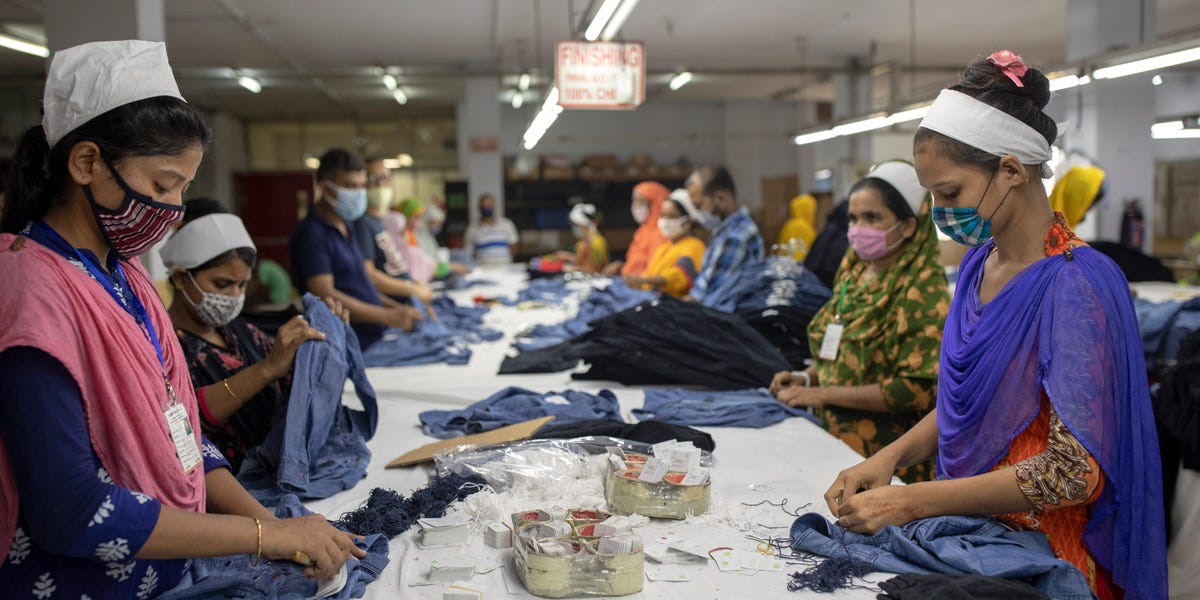
women make up over half of the garment sector workforce in Asia. They are disproportionately represented in low-wage jobs in the lower tiers of garment sector global supply chains. The report found that the average gender pay gap in the garment sector (in nine countries in Asia) is approximately 18 per cent. Worldwide, women in the garment sector are denied rights to maternity leave or childcare. They also face commonplace instances of intimidation, sexual abuse and harassment in workplaces as well as on the way to or from work.

Bangladesh Centre for Workers’ Solidarity campaigns for worker safety, fair wages and the right to labour unions.

Those involved in the campaign face risks, challenges and opportunities of being a human-rights defender but they feel it's worth it. In these factories issues such as unsafe working conditions, union-busting, insecure hours and wages, gender inequality, violence, and criminalisation are everywhere and justice needs to be sought. Everyone has a fundamental right to life and safety, Through collective action the campaigners believe, “change can come when workers fight together”. campaigning workers face tough times their voices criminalised,  fired and blacklisted just for raising their voice asking for a safe gender-based-violence-free workplace, and dignified wages.


children as young as 8 or 10 start working In the factories, working 100s of hours for a mere few dollars a month, on the feet all day for 10 hours or more, working in poor, dangerous and unhealthy conditions.

Covid-19 hit factories and therefore workers hard, brands just cancel their orders or deny to pay the bill that they would owe to the manufacturers, this directly impacted the workers. no work no pay. resulting in lack of money to buy food for themselves and their families.

This needs to be changed. And these changes can come when workers are united, when workers are fighting for their lives together one of the best tools for this is a union. Forming unions and joining with a union makes them united and strong, and their collective voice can bring the changes.

The unions are important because, in many cases, the laws of the country are not enforced. For example in Bangladesh there is a labour law, though it's not adequate or often enforced because there is a power collusion between business and politics.


 if there is a strong union in the factory, they can do the collective bargaining agreement with their respective factory management over the demands they have. And sometimes that agreement can be even beyond the law. for example living on poverty wages, but through the union agreement, if workers give a demand to receive a living wage, that can be discussed. 

Fashion Checkerhttps://fashionchecker.org

Union's are also important if women workers are willing to discuss gender-based violence during their collective bargaining agreement. It t can be discussed, and resolution can come to set up a committee in the factory and resolve all these problems and eliminate all the gender-based violence from the respective factories so that it would be a women-friendly workplace.

The campaigner workers sometimes face criminal charges, are often threatened, beaten, forced to fight .Being fired and blacklisted is very common.

When they defeated however, they still stand back up and fight did they start to win. Through a collective voice, through a union voice and union collective agreement, a change can become. A change is possible.

Clean Clothes Campaign: Amplifying worker voices in the garment and sportswear industry

Tuesday, 26 April 2022

FASHION: SOCIAL JUSTICE

“There is no generally accepted definition of social justice. The contemporary understanding of this normative concept has its roots in political philosophy, but different disciplines – including sociology, social psychology, law and jurisprudence, and human geography, among others – have contributed to its theoretical underpinnings and to defining its fundamental elements.” - Mona Khechen in Social Justice: Concepts, Principles, Tools and Challenges

Your views on social justice will reflect how you think society should work and what it should do. For many of us, this is intuitive. We don’t actively reflect on what we think is ‘just’, but it plays out in our everyday lives. In many cultures, the laws reflect accepted views, but these aren’t the same in all places, and they change over time.

We need to reflect on our own views about fashion and justice. Social justice is often seen in terms of equality, equity, rights, diversity or inclusion. It is about the distribution of power, resources, advantages and access that benefit some people and marginalise others.

we need to look at the definition of things and how we feel about them, do they overlap? are we directly affected? how can we change this?

https://remake.world/stories/news/how-fast-fashion-and-racism-are-intricately-linked/
  • Equality:  Equality is about ensuring that every individual has an equal opportunity to make the most of their lives and talents. It is also the belief that no one should have poorer life chances because of the way they were born, where they come from, what they believe, or whether they have a disability
  • Equity: 
    the quality of being fair and impartial.
    "equity of treatment"
  • Rights: that which is morally correct, just, or honorable.
  • Diversity: the practice or quality of including or involving people from a range of different social and ethnic backgrounds and of different genders, sexual orientations, etc.
  • Inclusion: 
    the practice or policy of providing equal access to opportunities and resources for people who might otherwise be excluded or marginalized, such as those who have physical or mental disabilities and members of other minority groups.
    "we value and promote diversity and inclusion in every aspect of our business"
  • Justice: 
    just behavior or treatment.
    "a concern for justice, peace, and genuine respect for people" 

 https://www.mckinsey.com/featured-insights/diversity-and-inclusion/diversity-in-fashion-voices-from-the-industry

Social injustice in and through fashion is experienced widely. It covers issues such as:

  • Workers’ rights
  • Cultural appropriation of clothes
  • Bullying people because of the clothes they wear
  • The unequal distribution of the economic rewards of fashion
  • Who can afford to buy clothes
  • The exploitation of models and interns
  • The effect of ecological harm caused by fashion on people’s lives.


Intersectionality and social injustice

Professor Kimberlé Crenshaw first coined the term in 1989. She defines intersectionality as “a lens through which you can see where power comes and collides, where it interlocks and intersects”. Intersectionality acknowledges the interconnected nature of social categorisations such as race, class and gender, regarded as creating overlapping and interdependent systems of discrimination or disadvantage.

Social injustice in fashion is not experienced equally. Factors including race, class and gender, as well as physical and psychological characteristics, affect fashion’s impact on society. For example, fashion companies profit from the exploitation of people, particularly women and people of colour, who make clothes and deal with fashion waste. Fashion media can exclude people with physical characteristics outside of the conventions of physical beauty. And universities, businesses and organisations often exclude people without particular education or the ‘right’ networks from the conversations and decisions about fashion and social justice.

“The only way we can tackle this issue is by decolonising fashion and elevating the voices of folks that have been traditionally ignored by the fashion industry” -  Intersectional Environmentalist

https://ethicalmadeeasy.com/theres-no-ethical-fashion-without-intersectionality/


https://www.collectivefashionjustice.org/articles/5-reasons-fashion-is-a-feminist-issue

Workers’ rights

Workers’ rights are enshrined in the United Nations Declaration of Human Rights and in the Conventions of the International Labour Organisation(ILO). However, workers throughout the fashion system routinely have their rights violated. Such rights include, but are not limited to, access to safe workplaces, freedom from sexual harassment and the ability to join trade unions to call for improved conditions.

Human trafficking, modern slavery and forced labour are among countless issues faced throughout the entire fashion supply chain worldwide. Fashion employs many millions of people globally, and the majority of these are women.


https://www.voguebusiness.com/sustainability/consumers-want-labour-rights-transparency-fashion-is-lagging

Working conditions in the garment sector are often characterised by long working hours and low pay in unsafe working conditions, amongst other decent work deficits.

It isn’t only garment workers that face violations of their rights. The #MeToo movement played a part in highlighting the exposure of models to verbal and sexual harassment in the fashion industry, and human trafficking has also been reported as a worldwide issue faced by models. Unpaid internships and unequal opportunities to progression in fashion demonstrate other ways in which rights are exploited.

Environmental justice

Environmental justice is defined by the Environmental Protection Agency as “the fair treatment and meaningful involvement of all people regardless of race, colour, national origin, or income, with respect to the development, implementation, and enforcement of environmental laws, regulations, and policies”. The environmental justice movement emerged in the US in the 1970s and 1980s, addressing the unequal distribution of environmental benefits and burdens. Sociologist Dr Robert Bullard is often described as the father of environmental justice. He states that “environmental justice embraces the principle that all people and communities have a right to equal protection and equal enforcement of environmental laws and regulations”. This applies to people living now, as well as future generations who will face the consequences of fashion today.

The ecological harm caused by fashion is disproportionately experienced by people who have no role in the decisions that led to the harm. The implications for workers and the communities now and in the future around garment hubs are stark, especially when low wages and insecure work increase vulnerability to ecological damage and decrease the ability to mitigate climate change impacts. In startling research by Cornell University, published in 2021, climate change is identified as likely to significantly contribute to flooding in the places where garment factories are located.


https://gizmodo.com/the-fast-fashion-industry-could-drown-itself-1848000176

Monday, 25 April 2022

FASHION: FILA X Y/PROJECT


FILA X Y/PROJECT
Experimental innovation of fashion movement and deconstruction advanced sports fashion Y / Project x FILA co branded series are on sale at the Paris fashion show
On the occasion of the 110th anniversary of the establishment of FILA, an Italian high-end sports fashion brand, Y / project, a highly popular deconstructive fashion brand operated by well-known designer Glenn Martens, launched a joint series with FILA, which perfectly integrates the bold design style of Y / project with FILA's sports gene, stunning the four. Now, the same Paris fashion show of this co branded series is listed globally on April 15.
In today's fashion world, no one can ignore the existence of ghostly designer Glenn martens. The winner of the French andam fashion award is as famous as the design director of Hermes and Maison Margiela. Once majoring in interior architectural design, after entering the field of fashion design, he introduced the "Deconstruction" aesthetics of "subversion, destruction and anti tradition" in the field of architecture into fashion design, forming a highly recognizable "Deconstruction" high street fashion style - stacked folds, exaggerated and interesting silhouettes, twisted collars, spliced and reconstructed trouser waists, asymmetric and removable design, etc., which quickly became popular. In the past 2022 spring and summer Paris Gaoding fashion week, he was in charge of three shows at the same time, which was truly the "top class" of the industry.
Y / project is led by Glenn martens. With its avant-garde and avant-garde style, Y / project is wildly sought after by international first-line stars, top supermodels and European and American trendsetters. At the same time, it is deeply loved by many top artists and stars in China.
For the Y / Project x FILA co branded series that will be limited to the market, Glenn Martens has given Y / Project style to FILA's key products, including T-shirts, hoodies, Polo neck dresses, windbreakers and sneakers. You can find y / project's iconic "deconstruction techniques, creative tailoring and neutral contour". The iconic elements of Y / project appear in the chic collar, stitched and reconstructed trousers, twisted trouser leg lines and superimposed folds, making the retro and elegant FILA unique, extremely eye-catching and full of avant-garde fashion.
Y / Project x FILA co branded series
The reason why we cooperate with FILA is that the concepts of the two brands in the fashion field agree with each other: Y / project's unique fashion attitude and design style interpret the avant-garde and pioneer spirit of the brand, which is highly recognized by the fashion industry; FILA, which is positioned as "high-end sports fashion", has been breaking through the boundaries of fashion and sports with a bold, open and young attitude, emitting irresistible charm for fashion people, and has walked out of a distinctive and personalized road among a number of sports brands.
It is worth mentioning that Glenn Martens spent a lot of time and energy in creating the co branding series, because he believed that "FILA wants to really do something creative and expressive", and that "this is a series of CO branding", rather than a combination of two logos.
Therefore, the joint brand series we see is the perfect integration of the two brand styles. Tracksuit in this series not only retains the avant-garde style of Y / Project deconstruction, but also has the characteristics of FILA sports, retro and elegant, which is very special. Glenn Martens took the famous BJ ö Borg tennis t as the inspiration and added FILA blue, white and red colors. The design team deconstructed and reorganized the trendy elements and the century old DNA of blue blood aristocrat FILA, elaborately created a unique fashion style and ingenious details, and perfectly decorated the clavicle.
As a leading brand that has maintained rapid growth in the field of fashion and sports in recent years, FILA's high popularity is inseparable from its long-term creation of brand fashion power. Among them, the co branding with fashion brands and the support of many stars are the most interesting.
Looking back on the past joint names of FILA, there are not only the global first-line luxury brands such as Fendi, but also the emerging American fashion brand 3.1 Phillip Lim, which is deeply sought after by Hollywood stars, as well as the Japanese high-end outdoor trend brand white mountaineering, which is widely loved by young people, and the Italian top outdoor brand C.P. company founded by Massimo Osti, the "godfather of metropolitan sportswear", and so on. What they like is FILA's ultra-high popularity among consumers in the field of advanced sports, continuous brand popularity, huge brand potential that has been continuously developed, rising brand value, and fashion fans that are difficult to measure. These joint cooperation not only expanded the fashion connotation of FILA high-end sports fashion, but also made more people in the fashion industry, especially the young people, know the distinctive FILA.
(can you put the pictures of clothes co branded by FILA and these brands here)
Moreover, FILA's unique fashion charm has attracted many stars. From CAI Xukun, Ouyang Nana, Kimura Guangxi K ō Ki, to Huang Jingyu, Jiang Shuying, Gao Yuanyuan, and then to Zhang Yixing, Ni Ni and Quan Zhixian, the strong star lineup affects different audience groups in different product lines, enriches the brand image of FILA's advanced fashion sports and further strengthens FILA's high-end fashion temperament.
Now, the cooperation with Glenn Martens has once again raised FILA's fashion tentacles to the level of international fashion pioneers, which has to be said to be the ultimate display of FILA's high-end sports fashion positioning.
It is reported that the Y / Project x FILA co branded series will be limited to market in... (Channel: tmall / online) on April 15. If you want to feel the new FILA sports product injected with Y / project design elements by Glenn Martens, a design genius, and want to wear the unique Y / Project x FILA co branded series of Paris fashion week, you must not miss the rush purchase.

FILA unites with French label Y/PROJECT to further innovative the daring spirit of the brand in a collection that emphasises individuality and independence through unisex designs. This collection radiates a bold streetwear feel made bolder by the graphic play of juxtaposed logos. Creative design features such as double collars and asymmetrical button features, allows for multiple ways to wear. Everyone can create their own style identity with FILA.
Y/PROJECT x FILA will be revealed during the Y/PROJECT fashion show on June 27th at 4pm . Tickets available from selected retailers and on www.yproject.fr 


Further collision of advanced sports fashion: limited opening of Centennial Y / Project x FILA joint series
Deep embrace fashion high-end sports fashion Y / Project x FILA joint series on sale
Y / Project x FILA joint hard core series on sale! See how FILA embraces advanced sports fashion
A new work of Centennial senior sports fashion is added, and the Y / Project x FILA co branded series is officially coming
On April 15, FILA, a high-end fashion and sports brand, and Y / project, a pioneer fashion designer, jointly launched the limited fashion series, which was officially launched worldwide. The designer Glenn Martens and brand Y / project jointly signed by FILA this time have a long history. At the autumn and winter fashion week in Paris and Milan in 2022, Glenn Martens took charge of three heavyweight fashion shows at the same time, and was rated as "the world's first outstanding designer in 2022" by the New York Times. In the past few years, with his unique deconstructive design style, he led the designer brand Y / project to become popular rapidly, which is sought after by many international stars and fashion supermodels. Many domestic first-line stars are also its loyal fans, and xiaohongshu fashion bloggers are also competing to be the first blogger of Y / Project. Now, FILA X Y / Project Co branded series is officially on the market, which means that trendy people can finally buy the same model of Y / Project x FILA co branded series that once appeared in Paris fashion week
Y / Project x FILA co branded series combines the representative architectural cutting and neutral contour of Y / project with the innovative power of century old FILA rooted in sports fashion and the iconic legendary blue and classic red tones to create a fresh and funny new high-level sports fashion series, which interprets the unique views of blue blood noble sports brand FILA on high-level sports fashion.
Continue the blue blood sports gene and redefine the high-end sports fashion
FILA, born in Italy, a country of fashion, was founded in 1911 and began to set foot in the field of sportswear in 1972. Different from others, FILA is not only involved in mass sports, but focuses on advanced sports such as tennis, aerobics, racing, water sports, skiing, golf and so on.
In 1972, FILA began to launch white line tennis knitwear. FILA broke the Convention in tennis sportswear and used colorful and eye-catching patterns. With the popularity of color TV in the 1970s, FILA began to be popular all over the world and realized the fashion change of tennis sportswear.


VIDEO CAMPAIGN
FILA unites with French label Y/PROJECT further innovating the daring spirit of the brand in a collection that emphasises individuality and independence through unisex designs. Radiating a bold streetwear feelcreative design features allow for multiple ways to wear so everyone can create their own style identity with FILA.
Y/PROJECT x FILA will be revealed during the Y/PROJECT fashion show on June 27th at 4pm.
FILA unites with Y/PROJECT further innovating the daring spirit of the brand in a collection that emphasises individuality and independence through high fashion unisex designs.  Creative design features allow multiple ways to wear - everyone can create their own style identity with FILA. 
The limited edition Y/PROJECT x FILA collection drops worldwide April 15th.
Redefining high end sports fashion one again! 
FILA unites with Y/PROJECT, further innovating the daring spirit of the brand in a collection that emphasises individuality and independence through stylish unisex designs.  Advanced creative design features allow multiple ways to wear - create their own fashion sports style identity with FILA.
The limited edition Y/PROJECT x FILA collection drops worldwide April 15th.


FILA and Y/Project reunite for a second time in this video collaboration. A campaign directed by Frederik Heyman and Kamiel Doens to celebrate FILA’s 110th anniversary. Channeling the spirit and innovativeness of FILA’S new collection, flying above and beyond in diverse adaptable unisex styles. Pioneering high end sports fashion design technology individually and together in collaborations, FILA continues to soar to the top. Y/PROJECT X FILA S022 collaboration has launched and taken off NOW!


Presenting FILA and Y/Project collaboration video campaign directed by A-lister projects award winner Frederik Heyman to celebrate FILA's 110th anniversary. Channeling the spirit and innovativeness of FILA's new collection, flying above and beyond in diverse adaptable unisex styles. Pioneering high-end sports fashion design technology individually and together in collaborations, FILA continues to soar to the top. Y/PROJECT X FILA SS22 collaboration has launched and taken off NOW!

#yproject #yprojectxfila #filaglobal


Redefining high end-sports fashion once again! A 2021 Paris fashion week headliner.

FILA unites with Y/PROJECT, further innovating the daring spirit of the brand in a collection that emphasises individuality and independence through stylish unisex designs. Advanced creative design features allow multiple ways to wear - create consumers' own fashion sports style identity with FILA.

The limited edition Y/PROJECT x FILA 2022 ss collection drops worldwide April 15th.

#yproject #yprojectxfila #filaglobal