Monday, 2 May 2022

FASHION: Social injustice in focus

 Fashion is both a reflection of and a catalyst for social change, and can play a crucial role in social justice. Social justice in fashion considers fair distribution of resources, the elimination of institutionalised domination and oppression, and the consequences of fashion decisions made in one place on another, and by one generation over those yet to be born.


The story of fashion and the story of the many fashions that make up our lives stem from a variety of influences and also personal references. Culture also plays a huge role, for some more than others. our fashion developed against a backdrop of varied street styles, music influences, and contemporary fashion scenes. some, develop a taste in multiple styles of fashion and clothing influenced by varied Western street styles alongside other culture diaspora styles, too. for example British Indians. 

So what might an intersectional approach to fashion look like? How might fashion centre the stories of fashion beyond Europe and of the producers alongside designers?what do we know about the work of design activists and movements that challenge inequalities in fashion, such as unfair labour practises and cultural appropriation, as a way for students to reimagine fashion. This approach leads to questions of ethics, social justice, accountability, appropriation, indigenization, and decolonization.

Such an approach echoes what theorist Arturo Escobar calls a design for the pluriverse. The term pluriverse, originally used by the Zapatistas, the Mexican revolutionary political and militant group, envisions a decolonial political world in which many worlds coexist and thus destabilises the concept of universality that has historically justified processes of colonial domination. The notion of the pluriverse acknowledges the entanglements and interconnectedness between different ways of being in the world, and Escobar argues is a way to regenerate people's spaces, their cultures and communities, and to reclaim the commons.

So, what's more fashionable, London's Bond Street or  for example Ealing Road, home to South Asian fashions in West London? The question is used as prompt to explore examples of marginalised forms of fashion practise that originate from the global South and show alternative counter-hegemonic ways of making fashion. While both areas have stalls with high-end luxury fashions, the fashions are very different. In Ealing Road, saris, a pre-colonial garment in the form of unstitched cloth, dominates the storefronts.

These discussions also open space to discuss more sustainable and social-justice-oriented ways of making fashion, such as the Sari for Change brand that trains low-income communities to recycle saris, to historical examples, such as the London-based campaign group Sari Squad, a group of women, mainly of South Asian origin, who wore saris as a form of visible protest against far-right racist groups in the UK in the 1980s. 

This can lead us to question how an alternative social-justice-oriented fashion design might address how colonialism and imperialism is about economic exploitation and dominance, and to understand why the Westernised fashion system operates to maintain cultural hierarchies. This involves a much deeper critical examination of how power operates globally in fashion to create and sustain racist and sexist hierarchies, and the role of coloniality thinking that established a justification for some, mainly European, countries to appropriate the land and resources of other countries.

Through this analysis, the fashion community can focus on three urgent issues. Firstly, how the option to decolonize fashion is more than about racial diversity. It's a long-term process to find ways for fashion colleges, fashion brands, and consumers to expose and offer alternatives to Eurocentric ideas about fashion. To do this, fashion needs to learn not just from designers, but also vernacular, everyday forms of fashion alongside grassroot activists to focus on ethical and environmental issues in fashion.

Secondly, it's more than about acknowledging colonial paths. To decolonize fashion requires moving towards alternative, anti- racist, and non-capitalist forms of fashion-design practise by learning with and from the global South. And thirdly, and most importantly, we need to decide whether we can even reform fashion-design cultures and practises, given the harm they are currently causing people and the planet, or whether we should be transforming and reimagining the fashion-design process altogether.

Journalist and campaigner Tansy Hoskins has explored the capitalist and patriarchal roots of fashion-design manufacturing, production, and consumption, and calls for a revision of the entire fashion-design system. And design theorist Sasha Costanza- Chock outlines the need for design justice, a design approach led by marginalised groups to challenge universalist design principles and practises.

So we need to urgently rethink fashion away from industry and towards people's lived experiences as a way to encourage a more relational and human approach to fashion, designing with people's differences to include everybody's fashion stories. It's only through doing this that a reorientation of fashion design towards a more ethical and political practise can be achieved. For fashion design to learn from rather than exploit marginalised and subaltern groups, it must create and offer spaces in which heterogeneous concepts of fashion can thrive and flourish.

There is an urgent need to explore alternative non-extractive, anti-racist and social justice-oriented forms of fashion design pedagogies.


ENVIRONMENTAL INJUSTICE 

GHANA

https://theor.org

An estimated 15 million items of unwanted clothing from the UK, Canada, USA, China, South Korea, Australia and other countries pour into Ghana each week.

Whilst Ghana is not the only country where unwanted clothing is ‘dumped’, what is happening in Ghana offers a stark example of environmental injustice.

These clothes are commonly known as obroni wawu – dead white man’s clothes. Secondhand clothes imports have created environmental disasters in Ghana, as well as severe health risks for the people who live and work around the related markets and landfill sites. The term ‘waste colonialism’ was first used at the Basel Convention in 1989, to describe the transboundary disposal of hazardous and toxic wastes.

https://eco-age.com/resources/decolonising-fashion-dead-white-mans-clothes-ghana/

Most of the items of clothing arrive at Kantamanto Market, the second largest secondhand market in West Africa. The market creates jobs for many people, and provides a space for entrepreneurs and styles. Products are curated, upcycled and, in some cases, sold back to other countries ‘with a little Ghanaian flair’.

https://www.abc.net.au/news/2021-08-12/fast-fashion-turning-parts-ghana-into-toxic-landfill/100358702

The market is also the site of backbreaking work for the female head porters, called kayayei, who carry the massive bales of clothes on their heads and risk serious injury.

Around six million items of the clothing leave the market as waste each week to be dumped. The destination of the majority of clothing waste from Kantamanto Market was, until 2019, Kpone landfill. More than 60% of the waste in this landfill site is estimated to be clothing. Waste pickers and the communities faced nausea, headaches, drowsiness, fatigue and respiratory problems, originating from the site.

The clothing waste began to overwhelm Kpone landfill within five years. Then, in August 2019, Kpone went up in flames, creating further respiratory problems, emitting noxious fumes and creating increasingly dangerous working environments for waste pickers. The site burned for 11 months.


The landfill site was decommissioned and capped in 2020, displacing over 300 waste pickers and levelling their community space.
Clothing waste in legal and illegal dumping continues to cause devastating problems in Ghana. It will continue to do so for as long as it takes the polyester, viscose and acrylic to decompose.
There isn’t capacity to transport all this clothing waste to new landfill sites, so it ends up in the streets. Here it creates environments for pests and disease to thrive. This clothing waste blocks the drainage and water systems, and damages the city’s ability to deal with life-threatening floods. Once the clothing has made its way to the ocean, it washes up in tangled knots of clothing or gets clogged up in the sand, up to 15 feet deep.

environmental justice map: https://ejatlas.org


Challenges and opportunities for human rights defenders in global fashion supply chains
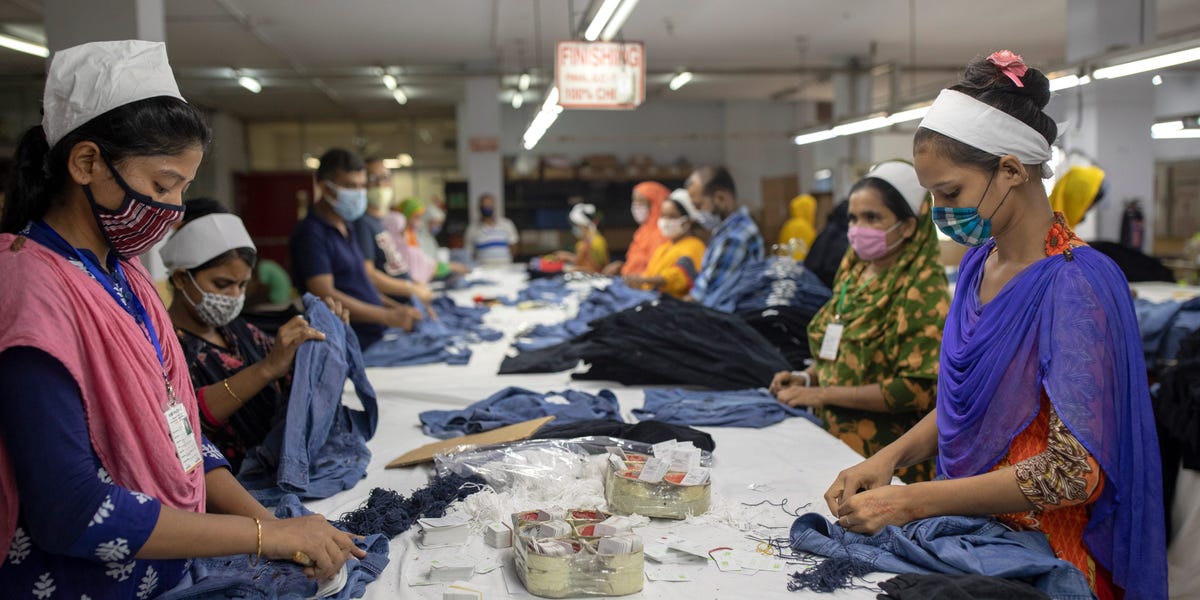


women make up over half of the garment sector workforce in Asia. They are disproportionately represented in low-wage jobs in the lower tiers of garment sector global supply chains. The report found that the average gender pay gap in the garment sector (in nine countries in Asia) is approximately 18 per cent. Worldwide, women in the garment sector are denied rights to maternity leave or childcare. They also face commonplace instances of intimidation, sexual abuse and harassment in workplaces as well as on the way to or from work.

Bangladesh Centre for Workers’ Solidarity campaigns for worker safety, fair wages and the right to labour unions.

Those involved in the campaign face risks, challenges and opportunities of being a human-rights defender but they feel it's worth it. In these factories issues such as unsafe working conditions, union-busting, insecure hours and wages, gender inequality, violence, and criminalisation are everywhere and justice needs to be sought. Everyone has a fundamental right to life and safety, Through collective action the campaigners believe, “change can come when workers fight together”. campaigning workers face tough times their voices criminalised,  fired and blacklisted just for raising their voice asking for a safe gender-based-violence-free workplace, and dignified wages.


children as young as 8 or 10 start working In the factories, working 100s of hours for a mere few dollars a month, on the feet all day for 10 hours or more, working in poor, dangerous and unhealthy conditions.

Covid-19 hit factories and therefore workers hard, brands just cancel their orders or deny to pay the bill that they would owe to the manufacturers, this directly impacted the workers. no work no pay. resulting in lack of money to buy food for themselves and their families.

This needs to be changed. And these changes can come when workers are united, when workers are fighting for their lives together one of the best tools for this is a union. Forming unions and joining with a union makes them united and strong, and their collective voice can bring the changes.

The unions are important because, in many cases, the laws of the country are not enforced. For example in Bangladesh there is a labour law, though it's not adequate or often enforced because there is a power collusion between business and politics.


 if there is a strong union in the factory, they can do the collective bargaining agreement with their respective factory management over the demands they have. And sometimes that agreement can be even beyond the law. for example living on poverty wages, but through the union agreement, if workers give a demand to receive a living wage, that can be discussed. 

Fashion Checkerhttps://fashionchecker.org

Union's are also important if women workers are willing to discuss gender-based violence during their collective bargaining agreement. It t can be discussed, and resolution can come to set up a committee in the factory and resolve all these problems and eliminate all the gender-based violence from the respective factories so that it would be a women-friendly workplace.

The campaigner workers sometimes face criminal charges, are often threatened, beaten, forced to fight .Being fired and blacklisted is very common.

When they defeated however, they still stand back up and fight did they start to win. Through a collective voice, through a union voice and union collective agreement, a change can become. A change is possible.

Clean Clothes Campaign: Amplifying worker voices in the garment and sportswear industry

Tuesday, 26 April 2022

FASHION: SOCIAL JUSTICE

“There is no generally accepted definition of social justice. The contemporary understanding of this normative concept has its roots in political philosophy, but different disciplines – including sociology, social psychology, law and jurisprudence, and human geography, among others – have contributed to its theoretical underpinnings and to defining its fundamental elements.” - Mona Khechen in Social Justice: Concepts, Principles, Tools and Challenges

Your views on social justice will reflect how you think society should work and what it should do. For many of us, this is intuitive. We don’t actively reflect on what we think is ‘just’, but it plays out in our everyday lives. In many cultures, the laws reflect accepted views, but these aren’t the same in all places, and they change over time.

We need to reflect on our own views about fashion and justice. Social justice is often seen in terms of equality, equity, rights, diversity or inclusion. It is about the distribution of power, resources, advantages and access that benefit some people and marginalise others.

we need to look at the definition of things and how we feel about them, do they overlap? are we directly affected? how can we change this?

https://remake.world/stories/news/how-fast-fashion-and-racism-are-intricately-linked/
  • Equality:  Equality is about ensuring that every individual has an equal opportunity to make the most of their lives and talents. It is also the belief that no one should have poorer life chances because of the way they were born, where they come from, what they believe, or whether they have a disability
  • Equity: 
    the quality of being fair and impartial.
    "equity of treatment"
  • Rights: that which is morally correct, just, or honorable.
  • Diversity: the practice or quality of including or involving people from a range of different social and ethnic backgrounds and of different genders, sexual orientations, etc.
  • Inclusion: 
    the practice or policy of providing equal access to opportunities and resources for people who might otherwise be excluded or marginalized, such as those who have physical or mental disabilities and members of other minority groups.
    "we value and promote diversity and inclusion in every aspect of our business"
  • Justice: 
    just behavior or treatment.
    "a concern for justice, peace, and genuine respect for people" 

 https://www.mckinsey.com/featured-insights/diversity-and-inclusion/diversity-in-fashion-voices-from-the-industry

Social injustice in and through fashion is experienced widely. It covers issues such as:

  • Workers’ rights
  • Cultural appropriation of clothes
  • Bullying people because of the clothes they wear
  • The unequal distribution of the economic rewards of fashion
  • Who can afford to buy clothes
  • The exploitation of models and interns
  • The effect of ecological harm caused by fashion on people’s lives.


Intersectionality and social injustice

Professor KimberlĂ© Crenshaw first coined the term in 1989. She defines intersectionality as “a lens through which you can see where power comes and collides, where it interlocks and intersects”. Intersectionality acknowledges the interconnected nature of social categorisations such as race, class and gender, regarded as creating overlapping and interdependent systems of discrimination or disadvantage.

Social injustice in fashion is not experienced equally. Factors including race, class and gender, as well as physical and psychological characteristics, affect fashion’s impact on society. For example, fashion companies profit from the exploitation of people, particularly women and people of colour, who make clothes and deal with fashion waste. Fashion media can exclude people with physical characteristics outside of the conventions of physical beauty. And universities, businesses and organisations often exclude people without particular education or the ‘right’ networks from the conversations and decisions about fashion and social justice.

“The only way we can tackle this issue is by decolonising fashion and elevating the voices of folks that have been traditionally ignored by the fashion industry” -  Intersectional Environmentalist

https://ethicalmadeeasy.com/theres-no-ethical-fashion-without-intersectionality/


https://www.collectivefashionjustice.org/articles/5-reasons-fashion-is-a-feminist-issue

Workers’ rights

Workers’ rights are enshrined in the United Nations Declaration of Human Rights and in the Conventions of the International Labour Organisation(ILO). However, workers throughout the fashion system routinely have their rights violated. Such rights include, but are not limited to, access to safe workplaces, freedom from sexual harassment and the ability to join trade unions to call for improved conditions.

Human trafficking, modern slavery and forced labour are among countless issues faced throughout the entire fashion supply chain worldwide. Fashion employs many millions of people globally, and the majority of these are women.


https://www.voguebusiness.com/sustainability/consumers-want-labour-rights-transparency-fashion-is-lagging

Working conditions in the garment sector are often characterised by long working hours and low pay in unsafe working conditions, amongst other decent work deficits.

It isn’t only garment workers that face violations of their rights. The #MeToo movement played a part in highlighting the exposure of models to verbal and sexual harassment in the fashion industry, and human trafficking has also been reported as a worldwide issue faced by models. Unpaid internships and unequal opportunities to progression in fashion demonstrate other ways in which rights are exploited.

Environmental justice

Environmental justice is defined by the Environmental Protection Agency as “the fair treatment and meaningful involvement of all people regardless of race, colour, national origin, or income, with respect to the development, implementation, and enforcement of environmental laws, regulations, and policies”. The environmental justice movement emerged in the US in the 1970s and 1980s, addressing the unequal distribution of environmental benefits and burdens. Sociologist Dr Robert Bullard is often described as the father of environmental justice. He states that “environmental justice embraces the principle that all people and communities have a right to equal protection and equal enforcement of environmental laws and regulations”. This applies to people living now, as well as future generations who will face the consequences of fashion today.

The ecological harm caused by fashion is disproportionately experienced by people who have no role in the decisions that led to the harm. The implications for workers and the communities now and in the future around garment hubs are stark, especially when low wages and insecure work increase vulnerability to ecological damage and decrease the ability to mitigate climate change impacts. In startling research by Cornell University, published in 2021, climate change is identified as likely to significantly contribute to flooding in the places where garment factories are located.


https://gizmodo.com/the-fast-fashion-industry-could-drown-itself-1848000176

Monday, 25 April 2022

FASHION: FILA X Y/PROJECT


FILA X Y/PROJECT
Experimental innovation of fashion movement and deconstruction advanced sports fashion Y / Project x FILA co branded series are on sale at the Paris fashion show
On the occasion of the 110th anniversary of the establishment of FILA, an Italian high-end sports fashion brand, Y / project, a highly popular deconstructive fashion brand operated by well-known designer Glenn Martens, launched a joint series with FILA, which perfectly integrates the bold design style of Y / project with FILA's sports gene, stunning the four. Now, the same Paris fashion show of this co branded series is listed globally on April 15.
In today's fashion world, no one can ignore the existence of ghostly designer Glenn martens. The winner of the French andam fashion award is as famous as the design director of Hermes and Maison Margiela. Once majoring in interior architectural design, after entering the field of fashion design, he introduced the "Deconstruction" aesthetics of "subversion, destruction and anti tradition" in the field of architecture into fashion design, forming a highly recognizable "Deconstruction" high street fashion style - stacked folds, exaggerated and interesting silhouettes, twisted collars, spliced and reconstructed trouser waists, asymmetric and removable design, etc., which quickly became popular. In the past 2022 spring and summer Paris Gaoding fashion week, he was in charge of three shows at the same time, which was truly the "top class" of the industry.
Y / project is led by Glenn martens. With its avant-garde and avant-garde style, Y / project is wildly sought after by international first-line stars, top supermodels and European and American trendsetters. At the same time, it is deeply loved by many top artists and stars in China.
For the Y / Project x FILA co branded series that will be limited to the market, Glenn Martens has given Y / Project style to FILA's key products, including T-shirts, hoodies, Polo neck dresses, windbreakers and sneakers. You can find y / project's iconic "deconstruction techniques, creative tailoring and neutral contour". The iconic elements of Y / project appear in the chic collar, stitched and reconstructed trousers, twisted trouser leg lines and superimposed folds, making the retro and elegant FILA unique, extremely eye-catching and full of avant-garde fashion.
Y / Project x FILA co branded series
The reason why we cooperate with FILA is that the concepts of the two brands in the fashion field agree with each other: Y / project's unique fashion attitude and design style interpret the avant-garde and pioneer spirit of the brand, which is highly recognized by the fashion industry; FILA, which is positioned as "high-end sports fashion", has been breaking through the boundaries of fashion and sports with a bold, open and young attitude, emitting irresistible charm for fashion people, and has walked out of a distinctive and personalized road among a number of sports brands.
It is worth mentioning that Glenn Martens spent a lot of time and energy in creating the co branding series, because he believed that "FILA wants to really do something creative and expressive", and that "this is a series of CO branding", rather than a combination of two logos.
Therefore, the joint brand series we see is the perfect integration of the two brand styles. Tracksuit in this series not only retains the avant-garde style of Y / Project deconstruction, but also has the characteristics of FILA sports, retro and elegant, which is very special. Glenn Martens took the famous BJ ö Borg tennis t as the inspiration and added FILA blue, white and red colors. The design team deconstructed and reorganized the trendy elements and the century old DNA of blue blood aristocrat FILA, elaborately created a unique fashion style and ingenious details, and perfectly decorated the clavicle.
As a leading brand that has maintained rapid growth in the field of fashion and sports in recent years, FILA's high popularity is inseparable from its long-term creation of brand fashion power. Among them, the co branding with fashion brands and the support of many stars are the most interesting.
Looking back on the past joint names of FILA, there are not only the global first-line luxury brands such as Fendi, but also the emerging American fashion brand 3.1 Phillip Lim, which is deeply sought after by Hollywood stars, as well as the Japanese high-end outdoor trend brand white mountaineering, which is widely loved by young people, and the Italian top outdoor brand C.P. company founded by Massimo Osti, the "godfather of metropolitan sportswear", and so on. What they like is FILA's ultra-high popularity among consumers in the field of advanced sports, continuous brand popularity, huge brand potential that has been continuously developed, rising brand value, and fashion fans that are difficult to measure. These joint cooperation not only expanded the fashion connotation of FILA high-end sports fashion, but also made more people in the fashion industry, especially the young people, know the distinctive FILA.
(can you put the pictures of clothes co branded by FILA and these brands here)
Moreover, FILA's unique fashion charm has attracted many stars. From CAI Xukun, Ouyang Nana, Kimura Guangxi K ĹŤ Ki, to Huang Jingyu, Jiang Shuying, Gao Yuanyuan, and then to Zhang Yixing, Ni Ni and Quan Zhixian, the strong star lineup affects different audience groups in different product lines, enriches the brand image of FILA's advanced fashion sports and further strengthens FILA's high-end fashion temperament.
Now, the cooperation with Glenn Martens has once again raised FILA's fashion tentacles to the level of international fashion pioneers, which has to be said to be the ultimate display of FILA's high-end sports fashion positioning.
It is reported that the Y / Project x FILA co branded series will be limited to market in... (Channel: tmall / online) on April 15. If you want to feel the new FILA sports product injected with Y / project design elements by Glenn Martens, a design genius, and want to wear the unique Y / Project x FILA co branded series of Paris fashion week, you must not miss the rush purchase.

FILA unites with French label Y/PROJECT to further innovative the daring spirit of the brand in a collection that emphasises individuality and independence through unisex designs. This collection radiates a bold streetwear feel made bolder by the graphic play of juxtaposed logos. Creative design features such as double collars and asymmetrical button features, allows for multiple ways to wear. Everyone can create their own style identity with FILA.
Y/PROJECT x FILA will be revealed during the Y/PROJECT fashion show on June 27th at 4pm . Tickets available from selected retailers and on www.yproject.fr 


Further collision of advanced sports fashion: limited opening of Centennial Y / Project x FILA joint series
Deep embrace fashion high-end sports fashion Y / Project x FILA joint series on sale
Y / Project x FILA joint hard core series on sale! See how FILA embraces advanced sports fashion
A new work of Centennial senior sports fashion is added, and the Y / Project x FILA co branded series is officially coming
On April 15, FILA, a high-end fashion and sports brand, and Y / project, a pioneer fashion designer, jointly launched the limited fashion series, which was officially launched worldwide. The designer Glenn Martens and brand Y / project jointly signed by FILA this time have a long history. At the autumn and winter fashion week in Paris and Milan in 2022, Glenn Martens took charge of three heavyweight fashion shows at the same time, and was rated as "the world's first outstanding designer in 2022" by the New York Times. In the past few years, with his unique deconstructive design style, he led the designer brand Y / project to become popular rapidly, which is sought after by many international stars and fashion supermodels. Many domestic first-line stars are also its loyal fans, and xiaohongshu fashion bloggers are also competing to be the first blogger of Y / Project. Now, FILA X Y / Project Co branded series is officially on the market, which means that trendy people can finally buy the same model of Y / Project x FILA co branded series that once appeared in Paris fashion week
Y / Project x FILA co branded series combines the representative architectural cutting and neutral contour of Y / project with the innovative power of century old FILA rooted in sports fashion and the iconic legendary blue and classic red tones to create a fresh and funny new high-level sports fashion series, which interprets the unique views of blue blood noble sports brand FILA on high-level sports fashion.
Continue the blue blood sports gene and redefine the high-end sports fashion
FILA, born in Italy, a country of fashion, was founded in 1911 and began to set foot in the field of sportswear in 1972. Different from others, FILA is not only involved in mass sports, but focuses on advanced sports such as tennis, aerobics, racing, water sports, skiing, golf and so on.
In 1972, FILA began to launch white line tennis knitwear. FILA broke the Convention in tennis sportswear and used colorful and eye-catching patterns. With the popularity of color TV in the 1970s, FILA began to be popular all over the world and realized the fashion change of tennis sportswear.


VIDEO CAMPAIGN
FILA unites with French label Y/PROJECT further innovating the daring spirit of the brand in a collection that emphasises individuality and independence through unisex designs. Radiating a bold streetwear feel,creative design features allow for multiple ways to wear so everyone can create their own style identity with FILA.
Y/PROJECT x FILA will be revealed during the Y/PROJECT fashion show on June 27th at 4pm.
FILA unites with Y/PROJECT further innovating the daring spirit of the brand in a collection that emphasises individuality and independence through high fashion unisex designs.  Creative design features allow multiple ways to wear - everyone can create their own style identity with FILA. 
The limited edition Y/PROJECT x FILA collection drops worldwide April 15th.
Redefining high end sports fashion one again! 
FILA unites with Y/PROJECT, further innovating the daring spirit of the brand in a collection that emphasises individuality and independence through stylish unisex designs.  Advanced creative design features allow multiple ways to wear - create their own fashion sports style identity with FILA.
The limited edition Y/PROJECT x FILA collection drops worldwide April 15th.


FILA and Y/Project reunite for a second time in this video collaboration. A campaign directed by Frederik Heyman and Kamiel Doens to celebrate FILA’s 110th anniversary. Channeling the spirit and innovativeness of FILA’S new collection, flying above and beyond in diverse adaptable unisex styles. Pioneering high end sports fashion design technology individually and together in collaborations, FILA continues to soar to the top. Y/PROJECT X FILA S022 collaboration has launched and taken off NOW!


Presenting FILA and Y/Project collaboration video campaign directed by A-lister projects award winner Frederik Heyman to celebrate FILA's 110th anniversary. Channeling the spirit and innovativeness of FILA's new collection, flying above and beyond in diverse adaptable unisex styles. Pioneering high-end sports fashion design technology individually and together in collaborations, FILA continues to soar to the top. Y/PROJECT X FILA SS22 collaboration has launched and taken off NOW!

#yproject #yprojectxfila #filaglobal


Redefining high end-sports fashion once again! A 2021 Paris fashion week headliner.

FILA unites with Y/PROJECT, further innovating the daring spirit of the brand in a collection that emphasises individuality and independence through stylish unisex designs. Advanced creative design features allow multiple ways to wear - create consumers' own fashion sports style identity with FILA.

The limited edition Y/PROJECT x FILA 2022 ss collection drops worldwide April 15th.

#yproject #yprojectxfila #filaglobal


Fashion, nature, society and psychology

 In The Three Ecologies, Felix Guattari argues that “it is quite wrong to make a distinction between action on the psyche, the socius and the environment… We need to kick the habit of sedative discourse… in order to apprehend the world through the interchangeable lenses of the three ecologies”.


so how to start?

for example, something small - the choice of cotton in the design of a t-shirt, and its relationship with nature, society and psychology. We can explain the choice of cotton in the design process in some simple ways by looking at some of the influences on the choice. For example:

  • T-shirts are always made of cotton (society: social norms)
  • Cotton is ‘cheap’ (society: economics)
  • Cotton keeps us cool (nature: human physiology, climate)
  • Cotton grows well in many parts of the world (nature: climate, soil)
  • Cotton feels nice on our bodies (psychology: wellbeing)
  • Too many cotton t-shirts are sold (society: economics)
  • Cotton workers are exposed to high levels of pesticides (society: health)
  • High levels of water are used on many cotton farms (nature: pollution)
  • Intensive cotton farming results in exhaustion of soil (nature: climate, soil)
  • Cotton t-shirts help us fit into society by wearing clothes similar to other people (psychology: identity)

what are some of the other influences on the choice of cotton from nature, society and psychology? 

natural or a blend? (nature: natural or man made?) is it ethically grown and produced? (nature & society: the conditions of the workers) how does the production affect the environment? (nature: the pollution and the environment)

we can start to see how nature, society and psychology influence design choices in fashion. however there are consequences of the cotton choice. For example:

other consequences for the choice of cotton from nature, society and psychology could include: price (society and economics) location/producer (society: economics and sometimes politics) 


from this it is very easy to see that fashion is entwined with nature, society and psychology.  

there are lots of questions we should ask ourselves that help us make choices and question the choices we make or have made before, why is cotton cheap or does cotton feel nice on our bodies? what are the reasons behind our choice/preference? perhaps its eco-friendly, a recycled fibre blend, there are social justice reasons such as ethical fair pay and living standards for garment workers’ rather than low pay and long working hours in harsh condition. Other reasons may include how often we have wash our clothes;  or when we discard our clothes - quality

we chose our clothes, brands and our fabrics for a variety of reasons, perhaps humanitarian reasons, we are vegan, we support eco, the price, the style, the availability, that it's a fashionable brand etc, This is a selection made not just by the designer/manufacture, but also the buyer, the store, the customer and you the wearer on a specific day/occasion. A simple design; a simple cotton tshirt for example, has a lot of thought gone into it pre and post production right down to the choice by  the wearer on when and where to wear it, and when to give it away/stop using it. 

UNFORTUNATELY 

There is a current limitation overall in the approach to looking at influences and consequences of fashion in general is that we miss the specifics, the small details that we take for granted and overlook. 

These include where the fashion practices are taking place, who the people affected are, what the specific fashion culture under discussion is, and when it is taking place. The picture will change when these aspects are taken into account. For example, the environmental harm from rain-fed cotton will be different to irrigated cotton. Climate change will affect garment workers in Bangladesh differently to how it will affect garment workers in the US. In the future, technology will undoubtedly be created to meet some of the challenges that fashion raises, and social norms will have changed too.

Trying to create, in our minds, this entangled picture of the relationship between fashion, nature, society and psychology can feel overwhelming. The point isn’t to create a full picture. The aim is to keep fashion, nature and society in our minds when we are thinking about fashion and sustainability and also fashion, social justice and injustice.

keeping this in mind will help us to keep open to possibilities and perhaps opportunities for change. Seeing the complex picture of how fashion is entangled with nature, society and psychology can be humbling. It can also help us to understand that we cannot always know what the best way is to bring about change, since complex situations do not have simple solutions. It can release us into knowing that there is no right answer; it can free us to play, explore, experiment and learn.

By acknowledging the complexities and keeping a reflective approach, our energies might be averted from maintaining the status quo, or making matters worse. This can also help us avoid unintended consequences.

Therefore, you are invited not only to keep this entanglement of nature, society and psychology in mind as we move to looking at social justice and injustice, but also to keep a reflective and experimental mindset.

https://supplycompass.com/sustainable-fashion-blog/systems-thinking/

https://www.routledgehandbooks.com/doi/10.4324/9780203519943.ch2

Sunday, 24 April 2022

FASHION AND SOCIETY: the 3 ecologies

The powers of fashion are beyond consumerism, through fashion as an expanded practice,  we can help its users to share capabilities and engage in more open processes of mutual acknowledgement and discovery. To shy from fashion intersecting with various forms of injustices that can be used to play a part in processes of exclusion and bullying. So how to do this?

In terms of fashion on a sustainability level, we also need to entangle it into the natural environment, the social environment, and into our mental environment to help us see where these injustices lie, for example the double standards the West. We don't apply the same model across the world or to other populations. We have, for example, environmental regulations. Trying to limit extraction and pollution and so on in the environmental ecology here in the West. But then, we outsource the labour and the production overseas to countries where, then, there will be extraction, pollution, and other types of labour injustices and so on. And of course, the mass extinction of animals, etc.

But as long as it doesn't happen here, it's OK if it happens there. So that's a typical type of injustice in which fashion is very much entangled these days. But we also have the social dimensions of fashion, the second ecology. A similar thing happening where a dominant group in society sets the standard of judgement across the whole population.

We tend to be lead by group that is already in society, well-educated, with fancy high earning jobs set a beauty standard (which can incoporate the desired/accepted skin colour, and race) and market it through media and by using a language that is deemed eloquent. They set they latest fashion and explicitly disregard other populations and the struggles of the populations are having to catch up, in that sense. So that's another type of injustice where you have a double standard at work within the social ecology. 

Mental ecologies, meaning that if my self-esteem and my sense of self-worth and my desires are actually entangled into what other groups coming from richer backgrounds or from positions of privilege. If they set the standard for my sense of self-worth, well then, there's again an injustice happening. And of course, we have the same kind of setting within the fashion system where this also happens across all three ecologies.

The social, environmental, and mental ecologies of daily life.  interactions from childhood in settings all around, school, work, daily life, public and private life or even online. for example  how you are treated on the school playground. or excluded  from night  clubs with a dress policy, like a code word to keep poor people or people of colour out.

Clothing is used as an excuse to actually sort people and exclude people in much more everyday ways than perhaps what we usually think. And of course, we can take the example of bullying, too. Of how bullying, in many cases, clothing is actually the excuse that is used when the cool kids are rejecting the losers on the playground. That they are saying, oh, we don't like that colour or whatever - think Mean girls, "on Wednesdays we wear pink" don't come and sit with us, you're not the cool guy and they say something about clothing. Because we all know that we shouldn't judge people by the surface. But this is what happens.

fashion is also so deeply entangled in our mental lives, for example lying about clothes-- "I got it in the "sales", "I just threw it on"  "I don't really care about clothes"

To wear clothes means that we put ourselves out there for others to look at and to see. There is no unmediated way of appearing before others where I can just transfer my inner mind into yours and it's all fine. You will see me and judge me. And this is, unfortunately, the way that social interaction works. But this is, of course, in that realm that fashion operates and can be so successful, but also can be so deeply unjust.

So the question here becomes, why do you lie? Why is it so uncomfortable to sometimes actually acknowledge that, well, I actually wish I was looking a little bit more sophisticated or  interesting. through dressing we can exercise a sense of control, a sense of self-authorship.  We choose what we buy and wear, how we style and accessorise it, we choose when we wear it, the occasion. There's something extremely powerful in that. 


So the BIG question for sustainability, the issues around injustice is, how do we make this fantastic possibility of self-authorship available to as many people as possible? At the same time, so we don't sacrifice the planet and create conflicts and undermine people's self-esteem and make them addicted to this medium.

But can you use it as a tool to develop a self-knowledge and take oneself on a journey to become what one really wishes to be in the world?

FASHION: FASHION AND SOCIETY, how fashion exploits

how could fashion  enable agency, collaboration, dignity and distinction, while recognising our shared territory and diverse identities ?

 Does fashion’s contribution to societies need rethinking? How is the dominant fashion system perpetuating injustice and exploitation? What does equity in fashion mean to you?


Fashion is about connectivity. It connects us to ourselves at personal and professional levels, helps us to connect across communities where we live and work. It connects us in place both geographically and in political terms. It also connects us to our histories, our families, our cultures, and really importantly as well, it connects us to the future.

So what we do now in relation to fashion leaves a legacy to those who come after us. It literally tells who we are both morally, ethically, and philosophically. For those involved in fashion as a creative endeavour, whether on a professional or a personal level, we do well to consider the words of Ai Weiwei č‰ľćśŞćśŞ.  

"There is no beauty, no aesthetic judgement that is not related to morals and how we look at the world"

[Ai Weiwei is a Chinese contemporary artist, documentarian, and activist. Ai grew up in the far northwest of China, where he lived under harsh conditions due to his father's exile. As an activist, he has been openly critical of the Chinese Government's stance on democracy and human rights].


Fashion is powerful. It's not only enabling exploitation, it's exhibiting exploitation as something to be applauded. 

The dominant fashion system perpetuates this idea of injustice and exploitation through the volume and speed of production, through the pressure on price, through this notion of the margin being the most important thing. This imbalance of power means that all involved are actually being exploited one way or another.


But this exploitation is imbalanced. It's very well documented. And whilst experienced differently at different points of the system, labour exploitation involves the work of many millions of people, mainly women, in forced labour, very often linked to sexual harassment and abuse. Modern day slavery is prevalent across the fashion system. It's been known about for a very long time. Now we absolutely have to find ways to stop it.

Ability, whether it's across race, class, gender, or age, is not seen equally. There are systems of oppression that make up the majority of what fashion looks like. Fashion creativity takes place across all parts of the world, all kinds of people. The representation of the human identity is about being creative, but the diversity of that in fashion is not fully visible.


It's better than it was, but it hasn't ceased. Fashion exploits people across the world in a way that is applauded on catwalks, in campaigns, in range meetings, in buy negotiations, and what is bought and worn. So, in what ways can fashion's social and legal licence to exploit be changed - what we can do, what we can expect others to do, and what we can stand up against.

Achieving equity in fashion means everybody having the opportunity to take part. It sounds quite simple. But for everybody to be recognised for their contribution means that we have to undo the social constructs of inequality.

It means there needs to be an equal chance for everyone to have access to livelihoods across fashion's activities. It means ensuring that what we do in one place doesn't adversely affect people in another. That's in different places or different times. If we think about intersectionality and intergenerational access to being, we need to consider not only the effects on people in other places right now, but also the effects of what we're doing now for future societies. Ultimately, we need to both decolonize and decarbonize fashion.

Can we hope to achieve this by creating and encouraging a new ethic to emerge in fashion practise.? How can we take the steps towards achieving it?


Society has been developed to allow exploration of how fashion can paradoxically be a force for societal good, creating agency, collaboration, dignity and distinction between people, whilst also establishing and perpetuating injustice and exploitation.

As individuals, communities and societies we can experience and bear witness to life-changing injustices, ranging from micro-aggressions to situations of conflict. So how we can use fashion to challenge injustices in the world around us? What alternative activities and behaviours in response to the question: ‘How to use fashion activism to challenge social injustice?’